Ch. 10 - Correlation and Regression
Triola - Elementary Statistics 14th Edition
Triola14th EditionElementary StatisticsISBN: 9780137366446Not the one you use?Change textbook
Chapter 10, Problem 10.1.5

Interpreting r
In Exercises 5–8, use a significance level of α = 0.05 and refer to the accompanying displays.
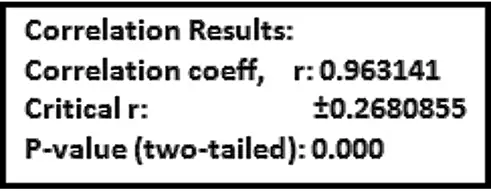
Bear Weight and Chest Size Fifty-four wild bears were anesthetized, and then their weights and chest sizes were measured and listed in Data Set 18 “Bear Measurements” in Appendix B; results are shown in the accompanying Statdisk display. Is there sufficient evidence to support the claim that there is a linear correlation between the weights of bears and their chest sizes? When measuring an anesthetized bear, is it easier to measure chest size than weight? If so, does it appear that a measured chest size can be used to predict the weight?
"Correlation coefficient 0.963, critical value ±0.269, p-value 0.000, indicating strong linear correlation."

Verified step by step guidance
1
Step 1: Understand the problem. We are tasked with determining if there is sufficient evidence to support the claim of a linear correlation between bear weights and chest sizes. Additionally, we need to assess if chest size can be used to predict weight.
Step 2: Identify the given data. From the image, the correlation coefficient (r) is 0.963141, the critical r value is ±0.2680855, and the p-value (two-tailed) is 0.000. The significance level (α) is 0.05.
Step 3: Compare the correlation coefficient (r) to the critical r value. If the absolute value of r is greater than the critical r, then there is evidence of a significant linear correlation.
Step 4: Evaluate the p-value. If the p-value is less than the significance level (α = 0.05), we reject the null hypothesis and conclude that there is a significant linear correlation.
Step 5: Interpret the results. If there is a significant linear correlation, consider whether chest size is easier to measure than weight and if it can be used as a predictor for weight. This involves practical reasoning based on the context of the problem.

Verified video answer for a similar problem:

This video solution was recommended by our tutors as helpful for the problem above.
Video duration:
2m
Was this helpful?

Key Concepts

Here are the essential concepts you must grasp in order to answer the question correctly.

Correlation Coefficient (r)

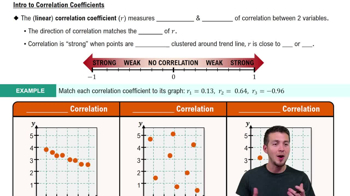
The correlation coefficient, denoted as 'r', quantifies the strength and direction of a linear relationship between two variables. Values range from -1 to 1, where 1 indicates a perfect positive correlation, -1 a perfect negative correlation, and 0 no correlation. In this case, an r value of 0.963 suggests a very strong positive correlation between bear weights and chest sizes.
Recommended video:
Guided course
05:43
Correlation Coefficient

P-value

The p-value measures the probability of obtaining results at least as extreme as the observed results, assuming the null hypothesis is true. A p-value of 0.000 indicates strong evidence against the null hypothesis, suggesting that the observed correlation is statistically significant. In this context, it implies that there is a significant linear correlation between the weights and chest sizes of bears.
Recommended video:
Guided course
06:50
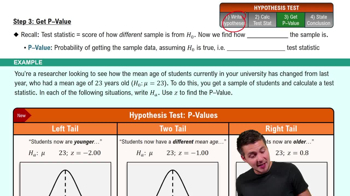
Step 3: Get P-Value

Significance Level (α)

The significance level, often denoted as α, is the threshold for determining whether a p-value indicates a statistically significant result. In this scenario, α is set at 0.05, meaning that if the p-value is less than 0.05, the null hypothesis can be rejected. Given the p-value of 0.000, the results are significant, supporting the claim of a linear correlation between the two measured variables.
Recommended video:
Guided course
04:46
Step 4: State Conclusion Example 4
Related Practice
Textbook Question

Finding the Best Model

In Exercises 5–16, construct a scatterplot and identify the mathematical model that best fits the given data. Assume that the model is to be used only for the scope of the given data, and consider only linear, quadratic, logarithmic, exponential, and power models.

Landing on the Moon When the Apollo spacecraft landed on the Moon, the rocket engine would typically cut off at about 1.3 meters above the surface so that hot gases and dust and other surface materials would not cause damage. The landing module was in freefall starting at about 1 meter above the surface. The table below lists the time t (seconds) after being dropped and the distance d (meters) travelled by an object dropped near the surface of the Moon.

1
views
Textbook Question

Garbage: Finding the Best Multiple Regression Equation

In Exercises 9–12, refer to the accompanying table, which was obtained by using the data from 62 households listed in Data Set 42 “Garbage Weight” in Appendix B. The response (y) variable is PLAS (weight of discarded plastic in pounds). The predictor (x) variables are METAL (weight of discarded metals in pounds), PAPER (weight of discarded paper in pounds), and GLASS (weight of discarded glass in pounds).

[IMAGE]

If exactly two predictor (x) variables are to be used to predict the weight of discarded plastic, which two variables should be chosen? Why?

4
views
Textbook Question

Interpreting R^2 For the multiple regression equation given in Exercise 1, we get R^2 = 0.897. What does that value tell us?

3
views
Textbook Question

se Notation Using Data Set 1 “Body Data” in Appendix B, if we let the predictor variable x represent heights of males and let the response variable y represent weights of males, the sample of 153 heights and weights results in se = 16.27555 cm. In your own words, describe what that value of se represents.

3
views
Textbook Question

Testing for a Linear Correlation

In Exercises 13–28, construct a scatterplot, and find the value of the linear correlation coefficient r. Also find the P-value or the critical values of r from Table A-6. Use a significance level of α = 0.05. Determine whether there is sufficient evidence to support a claim of a linear correlation between the two variables. (Save your work because the same data sets will be used in Section 10-2 exercises.)

Taxis Using the data from Exercise 15, is there sufficient evidence to support the claim that there is a linear correlation between the distance of the ride and the fare (cost of the ride)?

1
views
Textbook Question

Garbage: Finding the Best Multiple Regression Equation

In Exercises 9–12, refer to the accompanying table, which was obtained by using the data from 62 households listed in Data Set 42 “Garbage Weight” in Appendix B. The response (y) variable is PLAS (weight of discarded plastic in pounds). The predictor (x) variables are METAL (weight of discarded metals in pounds), PAPER (weight of discarded paper in pounds), and GLASS (weight of discarded glass in pounds).

[IMAGE]

If only one predictor (x) variable is used to predict the weight of discarded plastic, which single variable is best? Why?

3
views