Ch. 1 - Introduction to Statistics
Triola - Elementary Statistics 14th Edition
Triola14th EditionElementary StatisticsISBN: 9780137366446Not the one you use?Change textbook
Chapter 1, Problem 1.RE.7b

State Populations Currently, California has the largest population with 39,776,830 residents, and Wyoming has the smallest population with 573,520 residents.


b. What is the level of measurement for the numbers of residents in the different states? (nominal, ordinal, interval, ratio)

Verified step by step guidance
1
Understand the concept of levels of measurement: In statistics, data can be classified into different levels of measurement, which include nominal, ordinal, interval, and ratio. Each level provides different types of information and determines the types of statistical analyses that can be performed.
Define the nominal level: Nominal data is categorized without any order or ranking. It is simply used for labeling variables without any quantitative value.
Define the ordinal level: Ordinal data involves order or ranking, but the intervals between the ranks are not necessarily equal. It provides information about relative position but not the magnitude of difference.
Define the interval level: Interval data has ordered categories with equal intervals between them, but it lacks a true zero point. This means you can measure the difference between values, but not the ratio.
Define the ratio level: Ratio data has all the properties of interval data, with the addition of a true zero point, allowing for the comparison of absolute magnitudes and the calculation of ratios. The number of residents in different states is measured at the ratio level because it has a true zero point (zero residents) and allows for meaningful comparisons of absolute magnitudes.

Verified video answer for a similar problem:

This video solution was recommended by our tutors as helpful for the problem above.
Video duration:
2m
Was this helpful?

Key Concepts

Here are the essential concepts you must grasp in order to answer the question correctly.

Levels of Measurement

Levels of measurement refer to the different ways variables can be quantified and categorized. The four levels are nominal, ordinal, interval, and ratio. Each level provides different types of information and determines the types of statistical analyses that can be performed. Understanding these levels is crucial for selecting appropriate statistical methods.
Recommended video:
Guided course
10:28
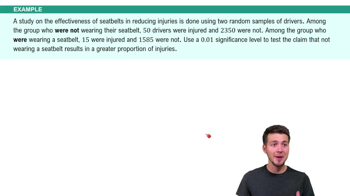
Difference in Proportions: Hypothesis Tests Example 1

Ratio Level of Measurement

The ratio level of measurement is the highest level, characterized by the presence of a true zero point, allowing for the comparison of absolute magnitudes. It supports all arithmetic operations, including meaningful ratios. In the context of state populations, the number of residents is a ratio measurement because it has a true zero (no residents) and allows for meaningful comparisons, such as one state having twice the population of another.
Recommended video:
Guided course
10:28
Difference in Proportions: Hypothesis Tests Example 1

Understanding True Zero

A true zero point in measurement indicates the absence of the quantity being measured, which is essential for ratio-level data. This allows for meaningful statements about how much more one entity has compared to another. In population data, a true zero means no residents, enabling comparisons like 'California has approximately 69 times the population of Wyoming.'
Recommended video:
Guided course
06:21
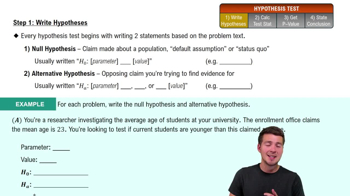
Step 1: Write Hypotheses
Related Practice
Textbook Question

Sampling For each of the following, identify the term that best describes the type of sample: systematic, convenience, stratified, cluster, or simple random sample.


d. A statistics student creates a survey and presents it to fellow statistics students.

2
views
Textbook Question

State Populations Currently, California has the largest population with 39,776,830 residents, and Wyoming has the smallest population with 573,520 residents.


a. Are the population sizes of the different states discrete or continuous?

2
views
Textbook Question

Paying for First Dates USA Today posted this question on the electronic version of its newspaper: “Should guys pay for the first date?” Of the 1148 subjects who decided to respond, 85% of them said “yes.”


c. Does the survey constitute an experiment or an observational study?

1
views
Textbook Question

Sampling For each of the following, identify the term that best describes the type of sample: systematic, convenience, stratified, cluster, or simple random sample.


a. As Lipitor pills are being manufactured, a quality control plan is to select every 500th pill and test it to confirm that it contains 80 mg of atorvastatin.

1
views
Textbook Question

Paying for First Dates USA Today posted this question on the electronic version of its newspaper: “Should guys pay for the first date?” Of the 1148 subjects who decided to respond, 85% of them said “yes.”


b. Is the value of 85% a statistic or a parameter?

1
views
Textbook Question

State Populations Currently, California has the largest population with 39,776,830 residents, and Wyoming has the smallest population with 573,520 residents.


d. If we randomly select 50 full-time workers in each of the 50 states, what type of sample is obtained? (random, systematic, convenience, stratified, cluster)

2
views