
Ch. 1 - Introduction to Statistics
Triola - Elementary Statistics 14th Edition
Triola14th EditionElementary StatisticsISBN: 9780137366446Not the one you use?Change textbook
Chapter 1, Problem 1.2.23

In Exercises 21–28, determine which of the four levels of measurement (nominal, ordinal, interval, ratio) best describes the given data.
Movie Ratings In a college film studies course, students rate ten documentaries using a scale of 0 to 5 stars.

Verified step by step guidance
1
Understand the four levels of measurement: Nominal, Ordinal, Interval, and Ratio. Nominal involves categories without a specific order. Ordinal involves categories with a specific order but without consistent differences between categories. Interval involves ordered categories with consistent differences but no true zero. Ratio involves ordered categories with consistent differences and a true zero.
Identify the nature of the data provided in the problem. The data consists of movie ratings given by students on a scale from 0 to 5 stars.
Consider whether the data has a natural order. In this case, the ratings from 0 to 5 stars do have a natural order, as a higher number of stars indicates a better rating.
Determine if the differences between the data points are meaningful. In this case, the difference between ratings (e.g., 4 stars vs. 3 stars) is consistent and meaningful.
Assess if there is a true zero point. In this context, a rating of 0 stars indicates the absence of any positive rating, which can be considered a true zero. Therefore, the data is best described by the ratio level of measurement.

Verified video answer for a similar problem:

This video solution was recommended by our tutors as helpful for the problem above.
Video duration:
2m
Was this helpful?

Key Concepts

Here are the essential concepts you must grasp in order to answer the question correctly.

Levels of Measurement

The levels of measurement refer to the different ways data can be categorized and quantified. They include nominal, ordinal, interval, and ratio scales. Each level has distinct characteristics that determine how data can be analyzed and interpreted, with nominal being the simplest and ratio the most complex.
Recommended video:
04:46
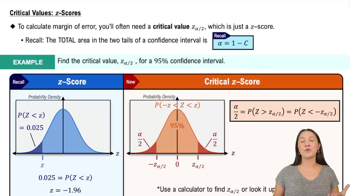
Critical Values: z Scores

Ordinal Scale

An ordinal scale is a type of measurement that ranks data in a specific order but does not quantify the difference between the ranks. In the context of movie ratings, a scale of 0 to 5 stars allows for ranking films based on preference, but the difference between ratings (e.g., between 2 and 3 stars) is not necessarily uniform or meaningful.
Recommended video:
Guided course
07:10
How to Create Histogram - TI-84 Calculator

Rating Scales

Rating scales are tools used to assess opinions or preferences, often represented numerically. In this case, the 0 to 5 star rating system allows students to express their evaluations of documentaries. Understanding how these ratings function helps in determining the appropriate level of measurement, as they reflect subjective judgments rather than precise measurements.
Recommended video:
Guided course
03:08
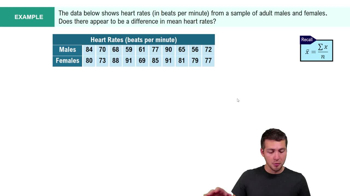
Calculating the Mean Example 1
Related Practice
Textbook Question

In Exercises 29–36, identify what is wrong.

Potatoes In a poll sponsored by the Idaho Potato Commission, 1000 adults were asked to select their favorite vegetables, and the favorite choice was potatoes, which were selected by 26% of the respondents.

1
views
Textbook Question

In Exercises 13–20, determine whether the results appear to have statistical significance, and also determine whether the results appear to have practical significance.


Mendel’s Genetics Experiments One of Gregor Mendel’s famous hybridization experiments with peas yielded 580 offspring with 152 of those peas (or 26%) having yellow pods. According to Mendel’s theory, 25% of the offspring peas should have yellow pods.

Textbook Question

Quantitative/Categorical Data Identify each of the following as quantitative data or categorical data


c. The colors of the M&M candies in Data Set 38 “Candies” in Appendix B

1
views
Textbook Question

In Exercises 29–36, identify what is wrong.

Storks and Babies In the years following the end of World War II, it was found that there was a strong correlation, or association, between the number of human births and the stork population. It therefore follows that storks cause babies.

1
views
Textbook Question

In Exercises 21–28, determine whether the study is an experiment or an observational study, and then identify a major problem with the study.

Atkins Weight Loss Program An independent researcher tested the effectiveness of the Atkins weight loss program by randomly selecting 1000 subjects using that program. Each of the subjects was called to report their weight before the diet and after the diet.

2
views
Textbook Question

In Exercises 29–36, identify what is wrong.

Cell Phones and Pirates In recent years, the numbers of cell phones and the numbers of pirates have both increased, so there is a correlation, or association, between those two variables. Therefore, pirates cause increases in cell phones.

1
views