Ch. 1 - Introduction to Statistics
Triola - Elementary Statistics 14th Edition
Triola14th EditionElementary StatisticsISBN: 9780137366446Not the one you use?Change textbook
Chapter 1, Problem 1.CQQ.6

Birth Weights For 100 randomly selected births from Bellevue Hospital Center, the birth weights are added and then divided by 100. The result is 3240 g. Is the value of 3240 g a statistic or a parameter?

Verified step by step guidance
1
Understand the difference between a statistic and a parameter: A statistic is a numerical value that describes a characteristic of a sample, while a parameter is a numerical value that describes a characteristic of a population.
Identify the sample and the population in the problem: The problem mentions 100 randomly selected births, which constitutes a sample from the larger population of all births at Bellevue Hospital Center.
Determine what the value 3240 g represents: Since the value is derived from the sample of 100 births, it is a measure of the average birth weight for this sample.
Recognize that because 3240 g is calculated from a sample, it is a statistic. A parameter would require data from the entire population of births at the hospital.
Conclude that the value of 3240 g is a statistic because it describes the average birth weight of the sample, not the entire population.

Verified video answer for a similar problem:

This video solution was recommended by our tutors as helpful for the problem above.
Video duration:
2m
Was this helpful?

Key Concepts

Here are the essential concepts you must grasp in order to answer the question correctly.

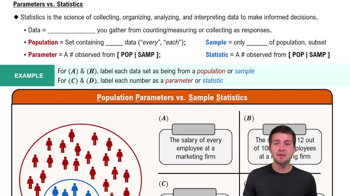
Statistic vs. Parameter

A statistic is a numerical value that describes a characteristic of a sample, while a parameter describes a characteristic of a population. In this context, the birth weights of 100 randomly selected births represent a sample, making the average weight of 3240 g a statistic, not a parameter.
Recommended video:
Guided course
05:53
Parameters vs. Statistics

Sample

A sample is a subset of a population selected for analysis. It is used to make inferences about the population without examining every individual. In the question, the 100 randomly selected births from Bellevue Hospital Center constitute a sample of the larger population of all births at the hospital.
Recommended video:
05:11
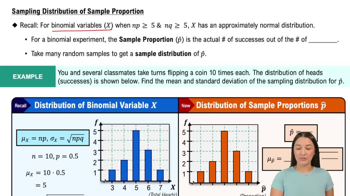
Sampling Distribution of Sample Proportion

Population

A population includes all members of a defined group that is being studied or analyzed. It is the complete set from which a sample is drawn. In this scenario, the population would be all births at Bellevue Hospital Center, while the sample is the 100 selected births.
Recommended video:
04:48
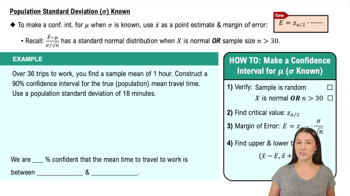
Population Standard Deviation Known
Related Practice
Textbook Question

In Exercises 9–12, the given expressions are designed to yield results expressed in a form of scientific notation. For example, the calculator-displayed result of 1.23E5 can be expressed as 123,000, and the result of 1.23E-4 can be expressed as 0.000123. Perform the indicated operation and express the result as an ordinary number that is not in scientific notation.


(0.2)^12

3
views
Textbook Question

Physicians’ Health Study In the Physicians’ Health Study, some of the subjects were treated with aspirin while others were given a placebo. For the subjects in this experiment, what is blinding?

1
views
Textbook Question

Determining Sample Size The given expression is used to determine the size of the sample necessary to estimate the proportion of college students who have the profound wisdom to take a statistics course. Find the value and round the result up to the next larger whole number.


[(1.95996)^2 - 0.25] / (0.03)^2

2
views
Textbook Question

Survey Which of the following best describes the level of measurement of the numbers 1, 2, 3, . . . , 410 described in Exercise 1: nominal, ordinal, interval, ratio?

1
views
Textbook Question

Standard Deviation One way to get a very rough approximation of the value of a standard deviation of sample data is to find the range, then divide it by 4. The range is the difference between the highest sample value and the lowest sample value. In using this approach, what value is obtained from the sample data listed in Exercise 1 “IQ Scores”?

2
views
Textbook Question

Birth Weights Refer to the sample described in Exercise 6. Because Bellevue Hospital Center agreed to provide the 100 birth weights, does the sample of birth weights constitute a voluntary response sample?

1
views