Ch. 9 - Correlation and Regression
Larson - Elementary Statistics: Picturing the World 8th Edition
Larson8th EditionElementary Statistics: Picturing the WorldISBN: 9780137493470Not the one you use?Change textbook
Chapter 9, Problem 9.1.38c

Writing Use an appropriate research source to find a real-life data set with the indicated cause-and-effect relationship. Write a paragraph describing each variable and explain why you think the variables have the indicated cause-and-effect relationship.
c. Coincidence: The relationship between the variables is a coincidence.

Verified step by step guidance
1
Identify a real-life data set where two variables appear to have a relationship, but the connection is coincidental rather than causal. For example, you might find a data set showing a correlation between ice cream sales and shark attacks.
Define the two variables in the data set. For instance, Variable 1 could be 'Ice Cream Sales' (measured in dollars or units sold), and Variable 2 could be 'Number of Shark Attacks' (measured as a count).
Explain the observed relationship between the two variables. For example, you might note that as ice cream sales increase, the number of shark attacks also increases.
Discuss why the relationship is coincidental and not causal. In this example, you could explain that both variables are influenced by a third factor, such as temperature or seasonality, which causes both ice cream sales and beach activity (leading to shark attacks) to increase simultaneously.
Write a paragraph summarizing the variables, their definitions, the observed relationship, and why the relationship is coincidental. Ensure the explanation is clear and concise, emphasizing the lack of direct causation between the variables.

Verified video answer for a similar problem:

This video solution was recommended by our tutors as helpful for the problem above.
Video duration:
1m
Was this helpful?

Key Concepts

Here are the essential concepts you must grasp in order to answer the question correctly.

Cause-and-Effect Relationship

A cause-and-effect relationship indicates that one variable directly influences another. In statistics, this is often established through experimental or observational studies where changes in an independent variable lead to changes in a dependent variable. Understanding this relationship is crucial for determining whether a correlation is meaningful or merely coincidental.
Recommended video:
Guided course
06:36
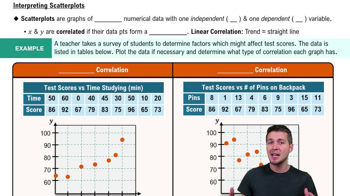
Scatterplots & Intro to Correlation

Correlation vs. Causation

Correlation refers to a statistical association between two variables, while causation implies that one variable directly affects the other. It is essential to distinguish between the two, as a strong correlation does not necessarily mean that one variable causes the other. This concept is vital when analyzing data sets to avoid misinterpretation of results.
Recommended video:
Guided course
05:43
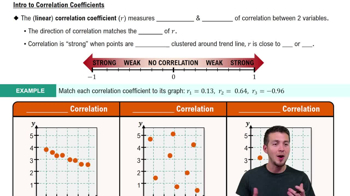
Correlation Coefficient

Coincidence

Coincidence occurs when two variables appear to be related but are actually linked by chance rather than a direct causal relationship. This can happen due to random fluctuations in data or the presence of confounding variables. Recognizing coincidence is important in statistical analysis to prevent drawing incorrect conclusions from data.
Recommended video:
Guided course
06:36
Scatterplots & Intro to Correlation