Ch. 9 - Correlation and Regression
Larson - Elementary Statistics: Picturing the World 8th Edition
Larson8th EditionElementary Statistics: Picturing the WorldISBN: 9780137493470Not the one you use?Change textbook
Chapter 9, Problem 9.3.8

"In Exercises 7-10, use the value of the correlation coefficient r to calculate the coefficient of determination r^2. What does this tell you about the explained variation of the data about the regression line? about the unexplained variation?
8.r =- 0.328"

Verified step by step guidance
1
Step 1: Recall the formula for the coefficient of determination, which is r². This is calculated by squaring the value of the correlation coefficient r. In this case, r = -0.328, so r² = (-0.328)².
Step 2: Compute r² by squaring the value of r. Note that squaring a negative number results in a positive value, so the sign of r does not affect r².
Step 3: Interpret the coefficient of determination (r²). It represents the proportion of the variation in the dependent variable (y) that is explained by the independent variable (x) through the regression line. For example, if r² = 0.107, this means 10.7% of the variation in y is explained by x.
Step 4: Calculate the unexplained variation. This is the remaining proportion of the variation in y that is not explained by x. It is given by 1 - r². For instance, if r² = 0.107, then the unexplained variation is 1 - 0.107 = 0.893, or 89.3%.
Step 5: Summarize the findings. The coefficient of determination (r²) quantifies how well the regression line fits the data. A higher r² value indicates a better fit, meaning more of the variation in y is explained by x. Conversely, a lower r² value indicates a weaker fit, with more unexplained variation.

Verified video answer for a similar problem:

This video solution was recommended by our tutors as helpful for the problem above.
Video duration:
2m
Was this helpful?

Key Concepts

Here are the essential concepts you must grasp in order to answer the question correctly.

Correlation Coefficient (r)

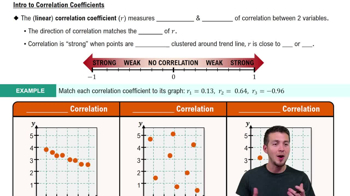
The correlation coefficient, denoted as 'r', measures the strength and direction of a linear relationship between two variables. Its value ranges from -1 to 1, where -1 indicates a perfect negative correlation, 1 indicates a perfect positive correlation, and 0 indicates no correlation. In this context, a negative value of r suggests that as one variable increases, the other tends to decrease.
Recommended video:
Guided course
05:43
Correlation Coefficient

Coefficient of Determination (r^2)

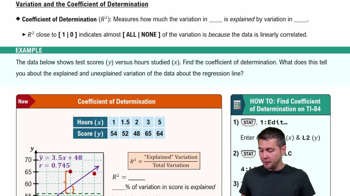
The coefficient of determination, represented as r^2, quantifies the proportion of variance in the dependent variable that can be explained by the independent variable in a regression model. It is calculated by squaring the correlation coefficient. An r^2 value close to 1 indicates that a large proportion of the variance is explained, while a value close to 0 suggests that little variance is explained.
Recommended video:
Guided course
06:14
Coefficient of Determination

Explained vs. Unexplained Variation

Explained variation refers to the portion of the total variation in the dependent variable that is accounted for by the regression model, as indicated by r^2. Conversely, unexplained variation is the portion that remains after accounting for the model, representing factors not captured by the independent variable. Understanding these concepts helps in assessing the effectiveness of the regression model in predicting outcomes.
Recommended video:
Guided course
04:39
Visualizing Qualitative vs. Quantitative Data