Ch. 8 - Hypothesis Testing with Two Samples
Larson - Elementary Statistics: Picturing the World 8th Edition
Larson8th EditionElementary Statistics: Picturing the WorldISBN: 9780137493470Not the one you use?Change textbook
Chapter 8, Problem 8.3.3

Test the claim about the mean of the differences for a population of paired data at the level of significance α. Assume the samples are random and dependent, and the populations are normally distributed.
Claim: μd<0 , α=0.05 , Sample statistics: d̄ =1.5 , sd=3.2 , n=14

Verified step by step guidance
1
Step 1: Identify the null hypothesis (H₀) and the alternative hypothesis (Hₐ). The null hypothesis is H₀: μd ≥ 0, and the alternative hypothesis is Hₐ: μd < 0, as the claim is that the mean of the differences is less than 0.
Step 2: Calculate the test statistic using the formula t = (d̄ - μd) / (sd / √n), where d̄ is the sample mean of the differences, μd is the hypothesized population mean of the differences (0 in this case), sd is the sample standard deviation of the differences, and n is the sample size.
Step 3: Determine the degrees of freedom (df) for the t-distribution. For a paired t-test, df = n - 1. In this case, df = 14 - 1 = 13.
Step 4: Find the critical value for a one-tailed t-test at the significance level α = 0.05 with df = 13. Use a t-distribution table or statistical software to find this value.
Step 5: Compare the calculated test statistic to the critical value. If the test statistic is less than the critical value, reject the null hypothesis H₀. Otherwise, fail to reject H₀. Interpret the result in the context of the claim.

Verified video answer for a similar problem:

This video solution was recommended by our tutors as helpful for the problem above.
Video duration:
3m
Was this helpful?

Key Concepts

Here are the essential concepts you must grasp in order to answer the question correctly.

Paired Data

Paired data refers to two sets of related observations, often collected from the same subjects under different conditions. This type of data is used in statistical tests to determine if there is a significant difference between the two conditions. In this context, the differences between paired observations are analyzed to test the claim about their mean.
Recommended video:
4:01
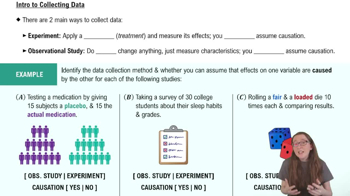
Introduction to Collecting Data

Hypothesis Testing

Hypothesis testing is a statistical method used to make inferences about population parameters based on sample data. It involves formulating a null hypothesis (H0) and an alternative hypothesis (H1), then using sample statistics to determine whether to reject H0. In this case, the null hypothesis would state that the mean of the differences is greater than or equal to zero, while the alternative claims it is less than zero.
Recommended video:
Guided course
06:21
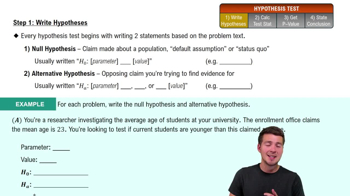
Step 1: Write Hypotheses

Level of Significance (α)

The level of significance, denoted as α, is the threshold for determining whether to reject the null hypothesis in hypothesis testing. It represents the probability of making a Type I error, which occurs when the null hypothesis is incorrectly rejected. In this scenario, α is set at 0.05, indicating a 5% risk of concluding that a difference exists when there is none.
Recommended video:
03:33
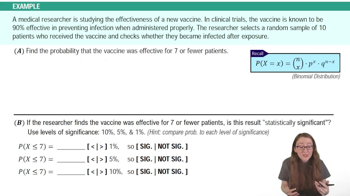
Finding Binomial Probabilities Using TI-84 Example 1
Related Practice
Textbook Question

In Exercises 11–14, test the claim about the difference between two population means and at the level of significance . Assume the samples are random and independent, and the populations are normally distributed.

Claim: μ1>μ2; α=0.10

Population statistics:σ1=40 and σ2=15

Sample Statistics: x̅1=500, n1=100, x̅2=495, n2=75

Textbook Question

Test the claim about the difference between two population means and at the level of significance α. Assume the samples are random and independent, and the populations are normally distributed.

Claim: μ1>μ2, α=0.01, Assume (σ1)^2≠(σ2)^2 

Sample statistics:

x̅1=52, s1=4.8, n1=32 and x̅2=50, s2=1.2, n2=40

Textbook Question

Testing a Difference Other Than Zero Sometimes a researcher is interested in testing a difference in means other than zero. In Exercises 27 and 28, you will test the difference between two means using a null hypothesis of Ho: μ1-μ2=k, Ho: μ1-μ2>=k or Ho: μ1-μ2<=k . The standardized test statistic is still

Software Engineer Salaries Is the difference between the mean annual salaries of entry level software engineers in Santa Clara, California, and Greenwich, Connecticut, more than \(4000? To decide, you select a random sample of entry level software engineers from each city. The results of each survey are shown in the figure at the left. Assume the population standard deviations are σ1=\)14,060 and σ2=\$13,050 . At α=0.05, what should you conclude? (Adapted from Salary.com)

Textbook Question

Explain how to perform a two-sample t-test for the difference between two population means.

Textbook Question

In Exercises 11–14, test the claim about the difference between two population means and at the level of significance . Assume the samples are random and independent, and the populations are normally distributed.

Claim: μ1=μ2; α=0.1

Population statistics:σ1=3.4 and σ2=1.5

Sample Statistics: x̅1=16, n1=29, x̅2=14, n2=28

Textbook Question

[APPLET] Tensile Strength

The tensile strength of a metal is a measure of its ability to resist tearing when it is pulled lengthwise. An experimental method of treatment produced steel bars with the tensile strengths (in newtons per square millimeter) listed below.

Experimental Method:

391 383 333 378 368 401 339 376 366 348

The conventional method produced steel bars with the tensile strengths (in newtons per square millimeter) listed below.

Conventional Method:

362 382 368 398 381 391 400410 396 411 385 385 395 371

At , α=0.01 can you support the claim that the experimental method of treatment makes a difference in the tensile strength of steel bars? Assume the population variances are equal.