Ch. 8 - Hypothesis Testing with Two Samples
Larson - Elementary Statistics: Picturing the World 8th Edition
Larson8th EditionElementary Statistics: Picturing the WorldISBN: 9780137493470Not the one you use?Change textbook
Chapter 8, Problem 8.Q.1a

Take this quiz as you would take a quiz in class. After you are done, check your work against the answers given in the back of the book.For each exercise, perform the steps below.


a. Identify the claim and state Ho and Ha


The mean score on a reading assessment test for 49 randomly selected male high school students was 279. Assume the population standard deviation is 41. The mean score on the same test for 50 randomly selected female high school students was 292. Assume the population standard deviation is 39. (Adapted from National Center for Education Statistics)

Verified step by step guidance
1
Step 1: Identify the claim. The claim is about comparing the mean scores of male and female high school students on a reading assessment test. Determine whether the claim is that one mean is greater than the other, or if they are different in some way.
Step 2: Define the null hypothesis (\(H_0\)) and the alternative hypothesis (\(H_a\)). Typically, the null hypothesis states that there is no difference between the population means, i.e., \(H_0: \mu_1 = \mu_2\), where \(\mu_1\) is the mean score for males and \(\mu_2\) is the mean score for females. The alternative hypothesis depends on the claim and could be \(H_a: \mu_1 \neq \mu_2\) (two-tailed), \(H_a: \mu_1 < \mu_2\), or \(H_a: \mu_1 > \mu_2\) (one-tailed).
Step 3: Note the sample statistics and population parameters given: sample sizes \(n_1 = 49\) (males), \(n_2 = 50\) (females); sample means \(\bar{x}_1 = 279\), \(\bar{x}_2 = 292\); population standard deviations \(\sigma_1 = 41\), \(\sigma_2 = 39\). These will be used to calculate the test statistic.
Step 4: Since population standard deviations are known, plan to use a two-sample z-test for the difference between means. The test statistic formula is: \[ Z = \frac{(\bar{x}_1 - \bar{x}_2) - (\mu_1 - \mu_2)}{\sqrt{\frac{\sigma_1^2}{n_1} + \frac{\sigma_2^2}{n_2}}} \] Under the null hypothesis, \(\mu_1 - \mu_2 = 0\).
Step 5: After calculating the test statistic, compare it to the critical z-value(s) based on the chosen significance level and the nature of the alternative hypothesis to decide whether to reject or fail to reject the null hypothesis.

Verified video answer for a similar problem:

This video solution was recommended by our tutors as helpful for the problem above.
Video duration:
2m
Was this helpful?

Key Concepts

Here are the essential concepts you must grasp in order to answer the question correctly.

Hypothesis Testing

Hypothesis testing is a statistical method used to make decisions about population parameters based on sample data. It involves stating a null hypothesis (Ho), which represents no effect or difference, and an alternative hypothesis (Ha), which represents the claim to be tested. The goal is to determine if there is enough evidence to reject Ho in favor of Ha.
Recommended video:
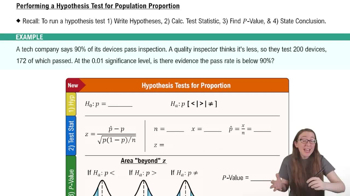
05:52
Performing Hypothesis Tests: Proportions

Sampling Distribution and Standard Error

The sampling distribution describes the distribution of a sample statistic, like the sample mean, over many samples. The standard error measures the variability of the sample mean and is calculated using the population standard deviation divided by the square root of the sample size. It helps assess how much the sample mean is expected to vary from the population mean.
Recommended video:
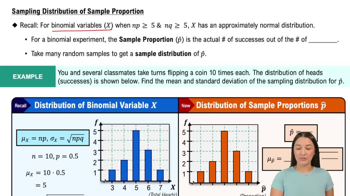
05:11
Sampling Distribution of Sample Proportion

Comparing Two Means with Known Population Standard Deviations

When comparing means from two independent samples with known population standard deviations, a two-sample z-test is used. This test evaluates whether the difference between sample means is statistically significant by considering the combined standard error of the difference. It helps determine if observed differences reflect true population differences or random variation.
Recommended video:
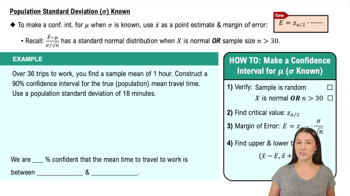
04:48
Population Standard Deviation Known
Related Practice
Textbook Question

In Exercises 1–4, classify the two samples as independent or dependent and justify your answer.


Sample 1: The retail prices of 20 motorcycles

Sample 2: The retail prices of 20 minivans
Textbook Question

Take this quiz as you would take a quiz in class. After you are done, check your work against the answers given in the back of the book.For each exercise, perform the steps below.

b. Determine whether the hypothesis test is left-tailed, right-tailed, or two-tailed, and whether to use a z-test or a t-test. Explain your reasoning.

The mean score on a reading assessment test for 49 randomly selected male high school students was 279. Assume the population standard deviation is 41. The mean score on the same test for 50 randomly selected female high school students was 292. Assume the population standard deviation is 39. At α=0.05, can you support the claim that the mean score on the reading assessment test for male high school students is less than the mean score for female high school students? (Adapted from National Center for Education Statistics)

Textbook Question

Take this quiz as you would take a quiz in class. After you are done, check your work against the answers given in the back of the book.For each exercise, perform the steps below.

f. Interpret the decision in the context of the original claim.

The mean score on a reading assessment test for 49 randomly selected male high school students was 279. Assume the population standard deviation is 41. The mean score on the same test for 50 randomly selected female high school students was 292. Assume the population standard deviation is 39. At α=0.05, can you support the claim that the mean score on the reading assessment test for male high school students is less than the mean score for female high school students? (Adapted from National Center for Education Statistics)

Textbook Question

Take this quiz as you would take a quiz in class. After you are done, check your work against the answers given in the back of the book.For each exercise, perform the steps below.


c. Find the critical value(s) and identify the rejection region(s).

The mean score on a reading assessment test for 49 randomly selected male high school students was 279. Assume the population standard deviation is 41. The mean score on the same test for 50 randomly selected female high school students was 292. Assume the population standard deviation is 39. At α=0.05, can you support the claim that the mean score on the reading assessment test for male high school students is less than the mean score for female high school students? (Adapted from National Center for Education Statistics)

Textbook Question

In Exercises 1–4, classify the two samples as independent or dependent and justify your answer.


Sample 1: The heights of 37 children

Sample 2: The heights of the same 37 children after 1 year

Textbook Question

In Exercises 29 and 30, (a) identify the claim and state Ho and Ha, (b) find the critical value(s) and identify the rejection region(s), (c) find the standardized test statistic z, (d) decide whether to reject or fail to reject the null hypothesis, and (e) interpret the decision in the context of the original claim. Assume the samples are random and independent.


A medical research team conducted a study to test the effect of a drug used to treat a type of inflammation. In the study, 68 subjects took the drug and 68 subjects took a placebo. The results are shown below. At α=0.05, can you reject the claim that the proportion of subjects who had at least 24 weeks of accrued remission is the same for the two groups? (Source: The New England Journal of Medicine)