Ch. 8 - Hypothesis Testing with Two Samples
Larson - Elementary Statistics: Picturing the World 8th Edition
Larson8th EditionElementary Statistics: Picturing the WorldISBN: 9780137493470Not the one you use?Change textbook
Chapter 8, Problem 8.1.2

Explain how to perform a two-sample z-test for the difference between two population means using independent samples with and known.

Verified step by step guidance
1
Step 1: State the null and alternative hypotheses. The null hypothesis (H₀) typically states that there is no difference between the population means (μ₁ = μ₂), while the alternative hypothesis (H₁) states that there is a difference (μ₁ ≠ μ₂, μ₁ > μ₂, or μ₁ < μ₂ depending on the context).
Step 2: Identify the sample statistics and population parameters. Gather the sample means (x̄₁ and x̄₂), sample sizes (n₁ and n₂), and the population standard deviations (σ₁ and σ₂) for both groups. Ensure the samples are independent and the population standard deviations are known.
Step 3: Calculate the test statistic (z). Use the formula: z=(x1-x2)σ1²n1+σ2²n2. This formula accounts for the difference in sample means and the variability of the two populations.
Step 4: Determine the critical value or p-value. Based on the significance level (α) and the type of test (one-tailed or two-tailed), find the critical z-value from the standard normal distribution table or calculate the p-value corresponding to the test statistic.
Step 5: Make a decision. Compare the test statistic to the critical value or use the p-value. If the test statistic exceeds the critical value or the p-value is less than α, reject the null hypothesis. Otherwise, fail to reject the null hypothesis. Interpret the results in the context of the problem.

Verified video answer for a similar problem:

This video solution was recommended by our tutors as helpful for the problem above.
Video duration:
3m
Was this helpful?

Key Concepts

Here are the essential concepts you must grasp in order to answer the question correctly.

Two-Sample Z-Test

A two-sample z-test is a statistical method used to determine if there is a significant difference between the means of two independent groups. This test is applicable when the population variances are known and the sample sizes are sufficiently large (typically n > 30). It compares the means by calculating a z-score, which indicates how many standard deviations the observed difference is from the expected difference under the null hypothesis.
Recommended video:
05:11
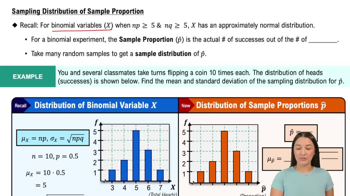
Sampling Distribution of Sample Proportion

Independent Samples

Independent samples refer to groups that are not related or paired in any way. In the context of a two-sample z-test, this means that the data collected from one sample does not influence or affect the data collected from the other sample. This independence is crucial for the validity of the test, as it ensures that the results are not biased by any relationship between the groups.
Recommended video:
Guided course
06:28
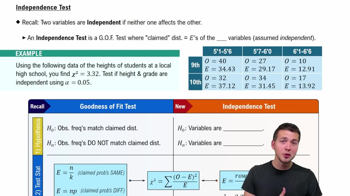
Independence Test

Population Means and Variances

Population means are the average values of a characteristic in a population, while population variances measure the spread of data points around the mean. In a two-sample z-test, knowing the population variances allows for the calculation of the standard error of the difference between the two means. This information is essential for determining the z-score and ultimately assessing whether the observed difference is statistically significant.
Recommended video:
04:48
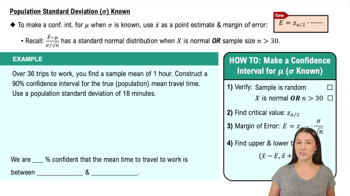
Population Standard Deviation Known
Related Practice
Textbook Question

What conditions are necessary to use the dependent samples t-test for the mean of the differences for a population of paired data?

Textbook Question

What conditions are necessary to use the t-test for testing the difference between two population means?

Textbook Question

[APPLET] Teaching Methods

A new method of teaching reading is being tested on third grade students. A group of third grade students is taught using the new curriculum. A control group of third grade students is taught using the old curriculum. The reading test scores for the two groups are shown in the back-to-back stem-and-leaf plot.

At , α=0.10 is there enough evidence to support the claim that the new method of teaching reading produces higher reading test scores than the old method does? Assume the population variances are equal.

Textbook Question

"Testing the Difference Between Two Means In Exercises 15–24, (a) identify the claim and state Ho and Ha, (b) find the critical value(s) and identify the rejection region(s), (c) find the standardized test statistic z, (d) decide whether to reject or fail to reject the null hypothesis, and (e) interpret the decision in the context of the original claim. Assume the samples are random and independent, and the populations are normally distributed.

[APPLET] Precipitation A climatologist claims that the precipitation in Seattle, Washington, was greater than in Birmingham, Alabama, in a recent year. The daily precipitation amounts (in inches) for 30 days in a recent year in Seattle are shown below. Assume the population standard deviation is 0.25 inch.

0.00 0.00 0.05 0.01 0.21 0.00 0.00 0.52 0.00 0.010.00 0.19 0.00 0.18 0.02 0.02 0.13 0.00 0.03 0.000.04 0.00 0.41 0.23 0.00 0.80 0.15 0.00 0.00 0.79

The daily precipitation amounts (in inches) for 30 days in a recent year in Birmingham are shown below. Assume the population standard deviation is 0.52 inch.

0.00 0.96 0.84 0.00 0.10 0.00 0.00 0.20 0.00 0.54 0.97 0.00 0.35 0.02 0.04 0.70 0.00 0.00 0.00 0.00 0.03 0.01 0.15 0.27 0.00 0.00 0.93 0.00 0.89 0.01

At α=0.05, can you support the climatologist’s claim? (Source: NOAA)"

Textbook Question

Annual Income

A politician claims that the mean household income in a recent year is greater in York County, South Carolina, than it is in Elmore County, Alabama. In York County, a sample of 23 residents has a mean household income of \$64,900 and a standard deviation of \$16,000. In Elmore County, a sample of 19 residents has a mean household income of \$59,500 and a standard deviation of \$23,600. At , α= 0.05can you support the politician’s claim? Assume the population variances are not equal. (Adapted from U.S. Census Bureau)

Textbook Question

Constructing Confidence Intervals for p1-p2 You can construct a confidence interval for the difference between two population proportions p1-p2 by using the inequality below.

(p^1p^2)zcp^1q^1n1+p^2q^2n2<p1p2<(p^1p^2)+zcp^1q^1n1+p^2q^2n2(\(\hat{p}\)_1 - \(\hat{p}\)_2) - z_c \(\sqrt{\frac{\hat{p}\)_1 \(\hat{q}\)_1}{n_1} + \(\frac{\hat{p}\)_2 \(\hat{q}\)_2}{n_2}} < p_1 - p_2 < (\(\hat{p}\)_1 - \(\hat{p}\)_2) + z_c \(\sqrt{\frac{\hat{p}\)_1 \(\hat{q}\)_1}{n_1} + \(\frac{\hat{p}\)_2 \(\hat{q}\)_2}{n_2}}

In Exercises 23–26, construct the indicated confidence interval for p1-p2. Assume the samples are random and independent.


Students Planning to Study Visual and Performing Arts In a survey of 10,000 students taking the SAT, 7% were planning to study visual and performing arts in college. In another survey of 8000 students taken 10 years before, 8% were planning to study visual and performing arts in college. Construct a 95% confidence interval for p1-p2, where p1 is the proportion from the recent survey and p2 is the proportion from the survey taken 10 years ago. (Adapted from College Board)

1
views