Ch. 7 - Hypothesis Testing with One Sample
Larson - Elementary Statistics: Picturing the World 8th Edition
Larson8th EditionElementary Statistics: Picturing the WorldISBN: 9780137493470Not the one you use?Change textbook
Chapter 7, Problem 7.1.56

Writing A null hypothesis is rejected with a level of significance of 0.10. Is it also rejected at a level of significance of 0.05? Explain.

Verified step by step guidance
1
Understand the concept of the level of significance: The level of significance (denoted as α) is the probability of rejecting the null hypothesis when it is actually true. A smaller α represents a stricter criterion for rejecting the null hypothesis.
Recognize the relationship between α = 0.10 and α = 0.05: A level of significance of 0.05 is more stringent than 0.10. This means that if a null hypothesis is rejected at α = 0.10, it does not necessarily mean it will be rejected at α = 0.05.
Recall the p-value approach: The p-value is the probability of observing the test statistic or something more extreme under the null hypothesis. If the p-value is less than or equal to the level of significance, the null hypothesis is rejected.
Compare the p-value to both levels of significance: If the p-value is less than or equal to 0.10 but greater than 0.05, the null hypothesis will be rejected at α = 0.10 but not at α = 0.05. If the p-value is less than or equal to 0.05, the null hypothesis will be rejected at both levels of significance.
Conclude based on the p-value: To determine whether the null hypothesis is rejected at α = 0.05, you need to know the p-value. If the p-value is not provided, you cannot definitively conclude whether the null hypothesis is rejected at the stricter level of significance.

Verified video answer for a similar problem:

This video solution was recommended by our tutors as helpful for the problem above.
Video duration:
1m
Was this helpful?

Key Concepts

Here are the essential concepts you must grasp in order to answer the question correctly.

Null Hypothesis

The null hypothesis is a statement that there is no effect or no difference, and it serves as the default assumption in hypothesis testing. Researchers aim to gather evidence to either reject or fail to reject this hypothesis based on sample data. In this context, rejecting the null hypothesis at a significance level indicates that the observed data is unlikely under the assumption that the null hypothesis is true.
Recommended video:
Guided course
06:21
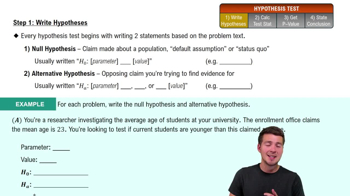
Step 1: Write Hypotheses

Level of Significance

The level of significance, often denoted as alpha (α), is the threshold for determining whether to reject the null hypothesis. It represents the probability of making a Type I error, which occurs when the null hypothesis is incorrectly rejected. Common levels of significance are 0.05 and 0.10, with lower values indicating stricter criteria for rejecting the null hypothesis.
Recommended video:
03:33
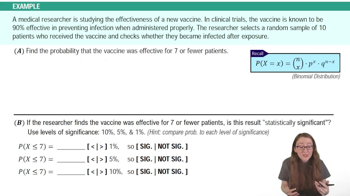
Finding Binomial Probabilities Using TI-84 Example 1

P-Value

The p-value is a statistical measure that helps determine the strength of the evidence against the null hypothesis. It quantifies the probability of observing the sample data, or something more extreme, if the null hypothesis is true. If the p-value is less than the chosen level of significance, the null hypothesis is rejected. Therefore, if a null hypothesis is rejected at 0.10, it may or may not be rejected at 0.05, depending on the p-value.
Recommended video:
Guided course
06:50
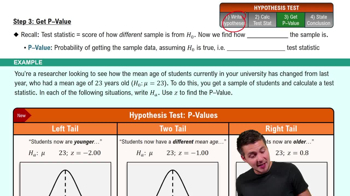
Step 3: Get P-Value