Ch. 7 - Hypothesis Testing with One Sample
Larson - Elementary Statistics: Picturing the World 8th Edition
Larson8th EditionElementary Statistics: Picturing the WorldISBN: 9780137493470Not the one you use?Change textbook
Chapter 7, Problem 7.4.17

use the figure at the left, which suggests what adults think about protecting the environment.


[Image]


Are People Concerned About Protecting the Environment? You interview a random sample of 100 adults. The results of the survey show that 58% of the adults said they live in ways that help protect the environment some of the time. At α=0.05, can you reject the claim that at least 64% of adults make an effort to live in ways that help protect the environment some of the time?

Verified step by step guidance
1
Step 1: Define the null hypothesis (H₀) and the alternative hypothesis (H₁). The null hypothesis is H₀: p ≥ 0.64, which states that at least 64% of adults make an effort to live in ways that help protect the environment. The alternative hypothesis is H₁: p < 0.64, which states that less than 64% of adults make such an effort.
Step 2: Identify the significance level (α). The problem specifies α = 0.05, which is the threshold for determining whether to reject the null hypothesis.
Step 3: Calculate the test statistic using the formula for a one-sample z-test for proportions: z = (p̂ - p₀) / √((p₀(1 - p₀)) / n), where p̂ is the sample proportion (0.58), p₀ is the hypothesized proportion (0.64), and n is the sample size (100).
Step 4: Determine the critical value for the z-test at α = 0.05 for a one-tailed test. Using a z-table or standard normal distribution, find the z-value corresponding to α = 0.05. This critical value will help decide whether to reject the null hypothesis.
Step 5: Compare the calculated z-test statistic to the critical value. If the test statistic is less than the critical value, reject the null hypothesis. Otherwise, fail to reject the null hypothesis. Interpret the result in the context of the problem.

Verified video answer for a similar problem:

This video solution was recommended by our tutors as helpful for the problem above.
Video duration:
4m
Was this helpful?

Key Concepts

Here are the essential concepts you must grasp in order to answer the question correctly.

Hypothesis Testing

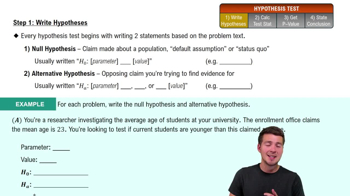
Hypothesis testing is a statistical method used to make decisions about a population based on sample data. It involves formulating a null hypothesis (H0) and an alternative hypothesis (H1). In this context, the null hypothesis states that at least 64% of adults make an effort to protect the environment, while the alternative suggests that this percentage is less than 64%. The goal is to determine whether the sample data provides sufficient evidence to reject the null hypothesis.
Recommended video:
Guided course
06:21
Step 1: Write Hypotheses

Significance Level (α)

The significance level, denoted as α, is the threshold for determining whether to reject the null hypothesis. In this case, α is set at 0.05, meaning there is a 5% risk of concluding that a difference exists when there is none (Type I error). If the p-value obtained from the hypothesis test is less than α, we reject the null hypothesis, indicating that the sample provides strong evidence against it.
Recommended video:
03:33
Finding Binomial Probabilities Using TI-84 Example 1

P-value

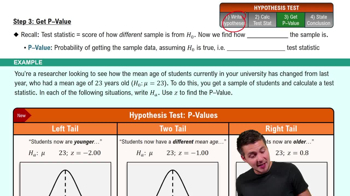
The p-value is a statistical measure that helps determine the strength of the evidence against the null hypothesis. It represents the probability of observing the sample data, or something more extreme, if the null hypothesis is true. In this scenario, calculating the p-value will help assess whether the observed proportion of adults (58%) significantly differs from the hypothesized proportion (64%), guiding the decision to reject or fail to reject the null hypothesis.
Recommended video:
Guided course
06:50
Step 3: Get P-Value
Related Practice
Textbook Question

Stating Hypotheses In Exercises 11–16, the statement represents a claim. Write its complement and state which is H0 and which is Ha.


μ ≤ 645

Textbook Question

Identifying Type I and Type II Errors In Exercises 31–36, describe type I and type II errors for a hypothesis test of the indicated claim.


Chess A local chess club claims that the length of time to play a game has a standard deviation of more than 12 minutes.

Textbook Question

In Exercises 3–8, find the critical value(s) and rejection region(s) for the type of t-test with level of significance alpha and sample size n.


Left-tailed test, α=0.10, n=38

Textbook Question

Hypothesis Testing Using Rejection Region(s) In Exercises 39–44, (a) identify the claim and state H0 and Ha, (b) find the critical value(s) and identify the rejection region(s), (c) find the standardized test statistic z, (d) decide whether to reject or fail to reject the null hypothesis, and (e) interpret the decision in the context of the original claim.


Light Bulbs A light bulb manufacturer guarantees that the mean life of a certain type of light bulb is at least 750 hours. A random sample of 25 light bulbs has a mean life of 745 hours. Assume the population is normally distributed and the population standard deviation is 60 hours. At alpha= 0.02, do you have enough evidence to reject the manufacturer’s claim?

Textbook Question

Identifying Type I and Type II Errors In Exercises 31–36, describe type I and type II errors for a hypothesis test of the indicated claim.


Video Game Systems A researcher claims that the percentage of U.S. gamers that are women is not 50%.

Textbook Question

In Exercises 7–12, find the critical value(s) and rejection region(s) for the type of chi-square test with sample size n and level of significance α.


Right-tailed test, n=10,α=0.10