
Ch. 7 - Hypothesis Testing with One Sample
Larson - Elementary Statistics: Picturing the World 8th Edition
Larson8th EditionElementary Statistics: Picturing the WorldISBN: 9780137493470Not the one you use?Change textbook
Chapter 7, Problem 7.1.46a

Interpreting a Decision In Exercises 43–48, determine whether the claim represents the null hypothesis or the alternative hypothesis. If a hypothesis test is performed, how should you interpret a decision that
         
a. rejects the null hypothesis?


Gas Mileage An automotive manufacturer claims that the standard deviation for the gas mileage of one of the vehicles it manufactures is 3.9 miles per gallon.

Verified step by step guidance
1
Identify the null hypothesis (H₀) and the alternative hypothesis (Hₐ). The null hypothesis typically represents the claim being tested. In this case, the automotive manufacturer claims that the standard deviation for the gas mileage is 3.9 miles per gallon. Thus, H₀: σ = 3.9, and the alternative hypothesis Hₐ would be that the standard deviation is not equal to 3.9 (Hₐ: σ ≠ 3.9).
Understand the interpretation of rejecting the null hypothesis. If the null hypothesis is rejected, it means there is sufficient evidence to support the alternative hypothesis. In this context, rejecting H₀ would suggest that the standard deviation of the gas mileage is not 3.9 miles per gallon.
Understand the interpretation of failing to reject the null hypothesis. If the null hypothesis is not rejected, it means there is not enough evidence to support the alternative hypothesis. In this case, it would suggest that the data does not provide sufficient evidence to conclude that the standard deviation is different from 3.9 miles per gallon.
Determine the type of test to be performed. Since the claim involves the standard deviation, a chi-square test for variance or standard deviation would be appropriate. The test statistic for a chi-square test is calculated as: χ2 = (n - 1)s2σ2, where n is the sample size, s² is the sample variance, and σ² is the claimed population variance.
Conclude the interpretation of the decision. If the null hypothesis is rejected, it means the manufacturer's claim about the standard deviation is not supported by the data. If the null hypothesis is not rejected, it means the data does not provide enough evidence to refute the manufacturer's claim.

Verified video answer for a similar problem:

This video solution was recommended by our tutors as helpful for the problem above.
Video duration:
4m
Was this helpful?

Key Concepts

Here are the essential concepts you must grasp in order to answer the question correctly.

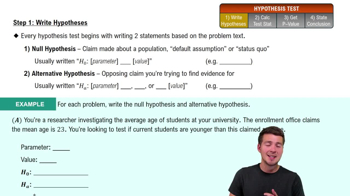
Null Hypothesis

The null hypothesis (H0) is a statement that indicates no effect or no difference, serving as a default position in hypothesis testing. In this context, it would assert that the standard deviation of gas mileage is equal to 3.9 miles per gallon. Researchers aim to test this hypothesis against an alternative hypothesis to determine if there is enough evidence to reject it.
Recommended video:
Guided course
06:21
Step 1: Write Hypotheses

Alternative Hypothesis

The alternative hypothesis (H1) is a statement that contradicts the null hypothesis, suggesting that there is an effect or a difference. In this scenario, it would propose that the standard deviation of gas mileage is not equal to 3.9 miles per gallon. This hypothesis is what researchers seek to support through statistical testing.
Recommended video:
Guided course
06:21
Step 1: Write Hypotheses

Hypothesis Testing

Hypothesis testing is a statistical method used to make inferences about population parameters based on sample data. It involves calculating a test statistic and comparing it to a critical value to decide whether to reject the null hypothesis. A decision to reject the null hypothesis indicates that the sample provides sufficient evidence to support the alternative hypothesis.
Recommended video:
Guided course
06:21
Step 1: Write Hypotheses