
Textbook Question
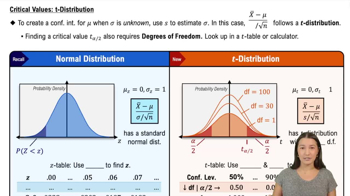
Explain how to find critical values for a t-distribution.

 Verified step by step guidance
 05:50
05:50
 09:56 05:50
Explain how to find critical values for a t-distribution.
Identifying a Test In Exercises 21–24, determine whether the hypothesis test is left-tailed, right-tailed, or two-tailed.
Ha: μ ≥ 5.2
H0: μ < 5.2
Graphical Analysis In Exercises 17–20, match the alternative hypothesis with its graph. Then state the null hypothesis and sketch its graph.
Ha: μ ≠ 3
a.
b.
c.
d.
Hypothesis Testing Using Rejection Regions In Exercises 7–12, (a) identify the claim and state H0 and Ha, (b) find the critical value(s) and identify the rejection region(s), (c) find the standardized test statistic z, (d) decide whether to reject or fail to reject the null hypothesis, and (e) interpret the decision in the context of the original claim.
Working Students An education researcher claims that 65% of full-time college students work year-round. In a random sample of 105 college students, 66 say they work year-round. At α=0.10, is there enough evidence to reject the researcher’s claim?
Faculty Classroom Hours The dean of a university estimates that the mean number of classroom hours per week for full-time faculty is 11.0. As a member of the student council, you want to test this claim. A random sample of the number of classroom hours for eight full-time faculty for one week is shown in the table at the left. At α=0.01, can you reject the dean’s claim?
True or False? In Exercises 5–10, determine whether the statement is true or false. If it is false, rewrite it as a true statement.
A statistical hypothesis is a statement about a sample.