
Ch. 7 - Hypothesis Testing with One Sample
Larson - Elementary Statistics: Picturing the World 8th Edition
Larson8th EditionElementary Statistics: Picturing the WorldISBN: 9780137493470Not the one you use?Change textbook
Chapter 7, Problem 7.RE.32

In Exercises 29–34, find the critical value(s) and rejection region(s) for the type of t-test with level of significance α and sample size n.


Left-tailed test, α=0.05, n=48

Verified step by step guidance
1
Step 1: Identify the degrees of freedom (df) for the t-test. The degrees of freedom are calculated as df = n - 1, where n is the sample size. In this case, df = 48 - 1 = 47.
Step 2: Recognize that this is a left-tailed t-test. For a left-tailed test, the critical value corresponds to the t-value where the cumulative probability equals the level of significance α.
Step 3: Use a t-distribution table or statistical software to find the critical t-value for df = 47 and α = 0.05. Look for the value where the cumulative probability is 0.05.
Step 4: Define the rejection region. For a left-tailed test, the rejection region includes all t-values less than the critical t-value found in Step 3.
Step 5: Summarize the results. The critical value and rejection region are now determined, and these will guide the decision to reject or fail to reject the null hypothesis based on the test statistic.

Verified video answer for a similar problem:

This video solution was recommended by our tutors as helpful for the problem above.
Video duration:
2m
Was this helpful?

Key Concepts

Here are the essential concepts you must grasp in order to answer the question correctly.

Critical Value

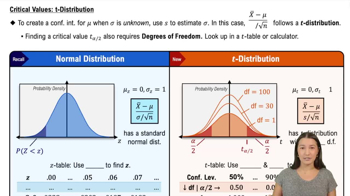
A critical value is a point on the scale of the test statistic that separates the region where the null hypothesis is rejected from the region where it is not rejected. In hypothesis testing, critical values are determined based on the significance level (α) and the type of test being conducted, such as one-tailed or two-tailed tests.
Recommended video:
05:50
Critical Values: t-Distribution

Rejection Region

The rejection region is the range of values for the test statistic that leads to the rejection of the null hypothesis. For a left-tailed test, this region is located to the left of the critical value, indicating that if the test statistic falls within this region, the null hypothesis can be rejected in favor of the alternative hypothesis.
Recommended video:
Guided course
09:56
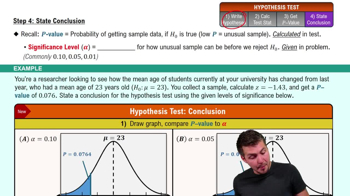
Step 4: State Conclusion

t-Test

A t-test is a statistical test used to determine if there is a significant difference between the means of two groups, especially when the sample size is small and the population standard deviation is unknown. The t-test uses the t-distribution, which accounts for sample size and variability, making it suitable for hypothesis testing in various scenarios.
Recommended video:
05:50
Critical Values: t-Distribution
Related Practice
Textbook Question

In Exercises 27 and 28, (a) identify the claim and state H0 and Ha, (b) find the critical value(s) and identify the rejection region(s), (c) find the standardized test statistic z, (d) decide whether to reject or fail to reject the null hypothesis, and (e) interpret the decision in the context of the original claim.


A substance abuse counselor claims that the mean annual drug overdose death rate for the 50 states is at least 25 deaths per 100,000 people. In a random sample of 30 states, the mean annual drug overdose rate is 22.48 per 100,000 people. Assume the population standard deviation is 10.69 deaths per 100,000. At α=0.01, is there enough evidence to reject the claim?

Textbook Question

In Exercises 7–10, explain how you should interpret a decision that rejects the null hypothesis.


A nonprofit consumer organization says that the standard deviation of the starting prices of its top-rated vehicles for a recent year is no more than \$2900.

Textbook Question

In Exercises 51–54, find the critical value(s) and rejection region(s) for the type of chi-square test with sample size n and level of significance.


Left-tailed test, n=6, α=0.05

Textbook Question

In Exercises 7–10, (a) state the null and alternative hypotheses and identify which represents the claim.

A nonprofit consumer organization says that the standard deviation of the starting prices of its top-rated vehicles for a recent year is no more than \$2900.

Textbook Question

In Exercises 7–10, describe type I and type II errors for a hypothesis test of the claim.


An energy bar maker claims that the mean number of grams of carbohydrates in one bar is less than 25.

Textbook Question

In Exercises 7–10, (c) explain whether the hypothesis test is left-tailed, right-tailed, or two-tailed.


An energy bar maker claims that the mean number of grams of carbohydrates in one bar is less than 25.