Ch. 7 - Hypothesis Testing with One Sample
Larson - Elementary Statistics: Picturing the World 8th Edition
Larson8th EditionElementary Statistics: Picturing the WorldISBN: 9780137493470Not the one you use?Change textbook
Chapter 7, Problem 7.3.18

In Exercises 13–18, test the claim about the population mean μ at the level of significance α. Assume the population is normally distributed.
Claim: μ≠52,200; α=0.05. Sample statistics: x_bar=53,220, s=2700, n=34

Verified step by step guidance
1
Step 1: State the null hypothesis (H₀) and the alternative hypothesis (H₁). The null hypothesis is H₀: μ = 52,200, and the alternative hypothesis is H₁: μ ≠ 52,200. This is a two-tailed test because the claim specifies 'not equal to.'
Step 2: Identify the test statistic to use. Since the population standard deviation is not provided and the sample size is relatively small (n = 34), use the t-test. The formula for the t-test statistic is: t = (x̄ - μ) / (s / √n), where x̄ is the sample mean, μ is the population mean under H₀, s is the sample standard deviation, and n is the sample size.
Step 3: Calculate the degrees of freedom (df) for the t-distribution. The degrees of freedom are given by df = n - 1. In this case, df = 34 - 1 = 33.
Step 4: Determine the critical t-value(s) for a two-tailed test at the significance level α = 0.05. Use a t-distribution table or statistical software to find the critical t-values corresponding to df = 33 and α/2 = 0.025 in each tail.
Step 5: Compare the calculated t-test statistic to the critical t-values. If the absolute value of the t-test statistic exceeds the critical t-value, reject the null hypothesis H₀. Otherwise, fail to reject H₀. Additionally, you can calculate the p-value and compare it to α to make the decision.

Verified video answer for a similar problem:

This video solution was recommended by our tutors as helpful for the problem above.
Video duration:
5m
Was this helpful?

Key Concepts

Here are the essential concepts you must grasp in order to answer the question correctly.

Hypothesis Testing

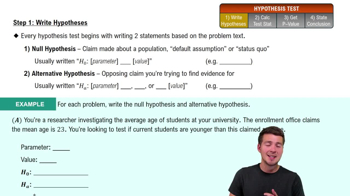
Hypothesis testing is a statistical method used to make decisions about a population based on sample data. It involves formulating a null hypothesis (H0) and an alternative hypothesis (H1). In this case, the null hypothesis states that the population mean μ equals 52,200, while the alternative hypothesis claims that it does not. The goal is to determine whether there is enough evidence to reject the null hypothesis at a specified significance level.
Recommended video:
Guided course
06:21
Step 1: Write Hypotheses

Significance Level (α)

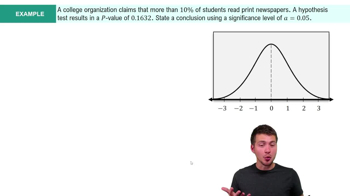
The significance level, denoted as α, is the threshold for determining whether to reject the null hypothesis. It represents the probability of making a Type I error, which occurs when the null hypothesis is incorrectly rejected. In this scenario, α is set at 0.05, indicating a 5% risk of concluding that a difference exists when there is none. This level helps to control the likelihood of false positives in hypothesis testing.
Recommended video:
Guided course
04:46
Step 4: State Conclusion Example 4

Confidence Interval

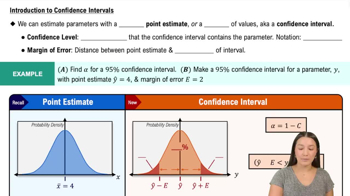
A confidence interval is a range of values derived from sample statistics that is likely to contain the population parameter with a certain level of confidence. In the context of hypothesis testing, it can be used to assess whether the population mean falls within a specified range. If the hypothesized mean (52,200) lies outside the confidence interval calculated from the sample data, it provides evidence against the null hypothesis.
Recommended video:
06:33
Introduction to Confidence Intervals
Related Practice
Textbook Question

Finding Critical Values and Rejection Regions In Exercises 23–28, find the critical value(s) and rejection region(s) for the type of z-test with level of significance α. Include a graph with your answer.


Two-tailed test, α = 0.12

Textbook Question

How do the requirements for a chi-square test for a variance or standard deviation differ from a z-test or a t-test for a mean?

Textbook Question

In Exercises 7–12, find the critical value(s) and rejection region(s) for the type of chi-square test with sample size n and level of significance α.


Left-tailed test, n=7,α=0.01

Textbook Question

Hypothesis Testing Using Rejection Regions In Exercises 19–26, (a) identify the claim and state H0 and Ha, (b) find the critical value(s) and identify the rejection region(s), (c) find the standardized test statistic t, (d) decide whether to reject or fail to reject the null hypothesis, and (e) interpret the decision in the context of the original claim. Assume the population is normally distributed.


Annual Salary An employment information service claims the mean annual salary for senior level statisticians is more than \(124,000. The annual salaries (in dollars) for a random sample of 12 senior level statisticians are shown in the table at the left. At α=0.01, is there enough evidence to support the claim that the mean salary is more than \)124,000?


Textbook Question

In Exercises 15–22, test the claim about the population variance or standard deviation at the level of significance Assume the population is normally distributed.

Claim: σ^2=63, α=0.01 . Sample statistics: s^2=58, n=29

Textbook Question

Stating the Null and Alternative Hypotheses In Exercises 25–30, write the claim as a mathematical statement. State the null and alternative hypotheses, and identify which represents the claim.


Paying for College According to a recent survey, 54% of today’s college students used student loans to pay for college.