Ch. 7 - Hypothesis Testing with One Sample
Larson - Elementary Statistics: Picturing the World 8th Edition
Larson8th EditionElementary Statistics: Picturing the WorldISBN: 9780137493470Not the one you use?Change textbook
Chapter 7, Problem 7.1.24

Identifying a Test In Exercises 21–24, determine whether the hypothesis test is left-tailed, right-tailed, or two-tailed.


Ha: p = 0.25
H0: p ≠ 0.25

Verified step by step guidance
1
Step 1: Understand the null hypothesis (H0) and the alternative hypothesis (Ha). In this case, H0: p = 0.25 and Ha: p ≠ 0.25.
Step 2: Recall that the type of test (left-tailed, right-tailed, or two-tailed) is determined by the alternative hypothesis (Ha).
Step 3: Note that Ha: p ≠ 0.25 indicates that the test is looking for evidence that the population proportion (p) is not equal to 0.25. This means the test is concerned with deviations in both directions (greater than or less than 0.25).
Step 4: A hypothesis test that considers deviations in both directions is called a two-tailed test.
Step 5: Conclude that this is a two-tailed test because the alternative hypothesis uses the 'not equal to' (≠) symbol, which implies interest in both tails of the distribution.

Verified video answer for a similar problem:

This video solution was recommended by our tutors as helpful for the problem above.
Video duration:
2m
Was this helpful?

Key Concepts

Here are the essential concepts you must grasp in order to answer the question correctly.

Hypothesis Testing

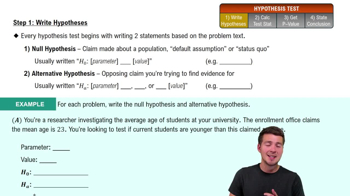
Hypothesis testing is a statistical method used to make decisions about a population based on sample data. It involves formulating two competing hypotheses: the null hypothesis (H0), which represents a statement of no effect or no difference, and the alternative hypothesis (Ha), which represents what we aim to support. The outcome of the test helps determine whether to reject the null hypothesis in favor of the alternative.
Recommended video:
Guided course
06:21
Step 1: Write Hypotheses

Types of Hypothesis Tests

Hypothesis tests can be classified as left-tailed, right-tailed, or two-tailed based on the nature of the alternative hypothesis. A left-tailed test is used when Ha indicates that a parameter is less than a certain value, while a right-tailed test is used when Ha indicates that it is greater. A two-tailed test is employed when Ha suggests that the parameter is simply different from a specified value, allowing for deviations in both directions.
Recommended video:
Guided course
06:21
Step 1: Write Hypotheses

Understanding p-values

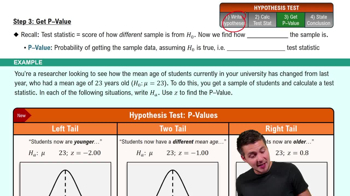
The p-value is a crucial component in hypothesis testing that helps determine the strength of the evidence against the null hypothesis. It represents the probability of observing the sample data, or something more extreme, assuming that the null hypothesis is true. A small p-value (typically less than 0.05) indicates strong evidence against H0, leading to its rejection in favor of Ha, while a larger p-value suggests insufficient evidence to reject H0.
Recommended video:
Guided course
06:50
Step 3: Get P-Value