
Textbook Question
In Exercises 13–18, test the claim about the population mean μ at the level of significance α. Assume the population is normally distributed.
Claim: μ=4915; α=0.01. Sample statistics: x_bar=5017, s=5613, n=51
 Verified step by step guidance
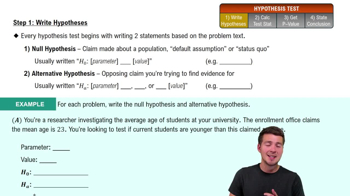
 06:21
06:21
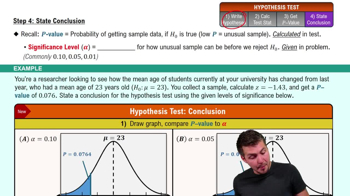 09:56
09:56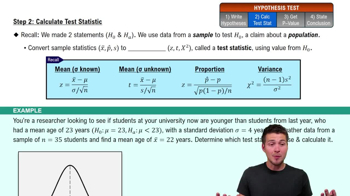 06:34
06:34In Exercises 13–18, test the claim about the population mean μ at the level of significance α. Assume the population is normally distributed.
Claim: μ=4915; α=0.01. Sample statistics: x_bar=5017, s=5613, n=51
Hypothesis Testing Using Rejection Region(s) In Exercises 39–44, (a) identify the claim and state H0 and Ha, (b) find the critical value(s) and identify the rejection region(s), (c) find the standardized test statistic z, (d) decide whether to reject or fail to reject the null hypothesis, and (e) interpret the decision in the context of the original claim.
[APPLET] Fluorescent Lamps A compact fluorescent lamp (CFL) bulb manufacturer guarantees that the mean life of a CFL bulb is at least 10,000 hours. You want to test this guarantee. To do so, you record the lives of a random sample of 32 CFL bulbs. The results (in hours) are listed. Assume the population standard deviation is 1850 hours. At alpha=0.11, do you have enough evidence to reject the manufacturer’s claim?
In Exercises 3–8, find the critical value(s) and rejection region(s) for the type of t-test with level of significance alpha and sample size n.
Left-tailed test, α=0.10, n=20
Identifying a Test In Exercises 21–24, determine whether the hypothesis test is left-tailed, right-tailed, or two-tailed.
Ha: μ ≤ 8.0
H0: μ > 8.0
True or False? In Exercises 5–10, determine whether the statement is true or false. If it is false, rewrite it as a true statement.
To support a claim, state it so that it becomes the null hypothesis.
What are the two types of hypotheses used in a hypothesis test? How are they related?