Ch. 7 - Hypothesis Testing with One Sample
Larson - Elementary Statistics: Picturing the World 8th Edition
Larson8th EditionElementary Statistics: Picturing the WorldISBN: 9780137493470Not the one you use?Change textbook
Chapter 7, Problem 7.2.10

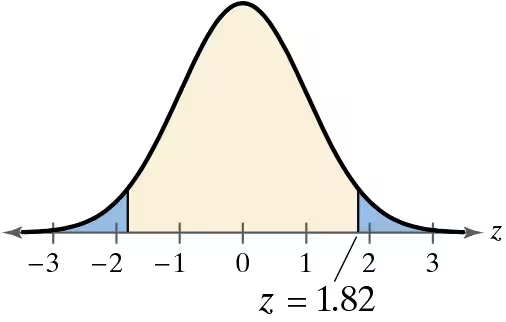
Graphical Analysis In Exercises 9–12, match the P-value or z-statistic with the graph that represents the corresponding area. Explain your reasoning.


P= 0.2802


<IMAGE>

Verified step by step guidance
1
Step 1: Understand the relationship between the P-value and the z-statistic. The P-value represents the probability of observing a test statistic as extreme as the one calculated, assuming the null hypothesis is true. The z-statistic corresponds to the number of standard deviations a data point is from the mean in a standard normal distribution.
Step 2: Analyze the graph provided. The graph shows a standard normal distribution with a z-statistic of 1.82. The shaded areas represent the tails of the distribution, which are used to calculate the P-value.
Step 3: Recall that for a two-tailed test, the P-value is the sum of the probabilities in both tails of the distribution. The z-statistic of 1.82 corresponds to the area in the right tail, and the left tail area is symmetric.
Step 4: Use a z-table or statistical software to find the cumulative probability for z = 1.82. Subtract this cumulative probability from 1 to find the area in the right tail. Multiply the tail area by 2 to account for both tails, yielding the P-value.
Step 5: Match the calculated P-value (approximately 0.2802) with the graph. The graph correctly represents the area corresponding to z = 1.82, as the shaded regions align with the calculated P-value for a two-tailed test.

Verified video answer for a similar problem:

This video solution was recommended by our tutors as helpful for the problem above.
Video duration:
2m
Was this helpful?

Key Concepts

Here are the essential concepts you must grasp in order to answer the question correctly.

P-value

The P-value is a statistical measure that helps determine the significance of results from a hypothesis test. It represents the probability of obtaining a test statistic at least as extreme as the one observed, assuming the null hypothesis is true. A smaller P-value indicates stronger evidence against the null hypothesis, often leading to its rejection.
Recommended video:
Guided course
06:50
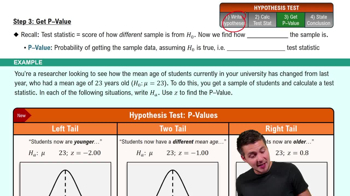
Step 3: Get P-Value

Z-statistic

The Z-statistic is a standardized score that indicates how many standard deviations an element is from the mean of a distribution. It is calculated by subtracting the mean from the observed value and dividing by the standard deviation. In hypothesis testing, the Z-statistic helps determine the position of a sample mean relative to the population mean under the null hypothesis.
Recommended video:
Guided course
06:31
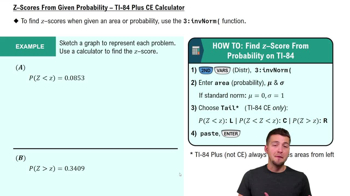
Z-Scores From Given Probability - TI-84 (CE) Calculator

Normal Distribution

The normal distribution is a continuous probability distribution characterized by its bell-shaped curve, defined by its mean and standard deviation. It is symmetric around the mean, with approximately 68% of the data falling within one standard deviation, 95% within two, and 99.7% within three. Many statistical tests assume normality, making it a fundamental concept in statistics.
Recommended video:
06:23
Using the Normal Distribution to Approximate Binomial Probabilities
Related Practice