Ch. 7 - Hypothesis Testing with One Sample
Larson - Elementary Statistics: Picturing the World 8th Edition
Larson8th EditionElementary Statistics: Picturing the WorldISBN: 9780137493470Not the one you use?Change textbook
Chapter 7, Problem 7.T.5

A nutrition bar manufacturer claims that the standard deviation of the number of grams of carbohydrates in a bar is 1.11 grams. A random sample of 26 bars has a standard deviation of 1.19 grams. At α=0.05, is there enough evidence to reject the manufacturer’s claim? Assume the population is normally distributed.

Verified step by step guidance
1
State the null hypothesis (H₀) and the alternative hypothesis (Hₐ). H₀: σ = 1.11 (the population standard deviation is 1.11 grams). Hₐ: σ ≠ 1.11 (the population standard deviation is not 1.11 grams). This is a two-tailed test.
Identify the test statistic to use. Since we are testing the population standard deviation, we use the chi-square test for variance. The test statistic is χ² = (n - 1) * (s² / σ₀²), where n is the sample size, s is the sample standard deviation, and σ₀ is the claimed population standard deviation.
Substitute the given values into the formula. Here, n = 26, s = 1.19, and σ₀ = 1.11. First, calculate the sample variance (s² = 1.19²) and the claimed variance (σ₀² = 1.11²). Then compute χ² using the formula χ² = (n - 1) * (s² / σ₀²).
Determine the critical values for the chi-square distribution. Use the chi-square table with degrees of freedom (df = n - 1 = 25) and the significance level α = 0.05. Since this is a two-tailed test, divide α by 2 to find the critical values for the lower and upper tails.
Compare the calculated χ² value to the critical values. If the χ² value falls outside the range defined by the critical values, reject the null hypothesis. Otherwise, fail to reject the null hypothesis. Interpret the result in the context of the problem.

Verified video answer for a similar problem:

This video solution was recommended by our tutors as helpful for the problem above.
Video duration:
4m
Was this helpful?

Key Concepts

Here are the essential concepts you must grasp in order to answer the question correctly.

Standard Deviation

Standard deviation is a measure of the amount of variation or dispersion in a set of values. In this context, it quantifies how much the carbohydrate content in the nutrition bars deviates from the average. A smaller standard deviation indicates that the values tend to be closer to the mean, while a larger one suggests more spread out values.
Recommended video:
Guided course
08:45
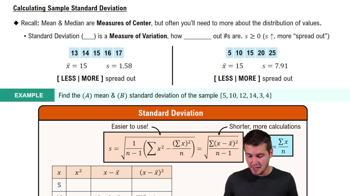
Calculating Standard Deviation

Hypothesis Testing

Hypothesis testing is a statistical method used to make decisions about a population based on sample data. In this scenario, the null hypothesis (H0) states that the manufacturer's claim about the standard deviation is true, while the alternative hypothesis (H1) suggests it is not. The goal is to determine if the sample data provides sufficient evidence to reject H0.
Recommended video:
Guided course
06:21
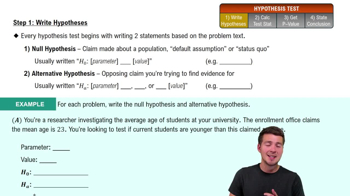
Step 1: Write Hypotheses

Significance Level (α)

The significance level, denoted as α, is the threshold for determining whether to reject the null hypothesis. In this case, α is set at 0.05, meaning there is a 5% risk of concluding that a difference exists when there is none. If the p-value obtained from the hypothesis test is less than α, the null hypothesis can be rejected, indicating significant evidence against the manufacturer's claim.
Recommended video:
03:33
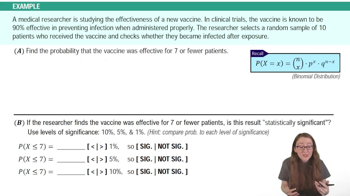
Finding Binomial Probabilities Using TI-84 Example 1
Related Practice
Textbook Question

Writing Hypotheses: Internet Provider An Internet provider is trying to gain advertising deals and claims that the mean time a customer spends online per day is greater than 28 minutes. You are asked to test this claim. How would you write the null and alternative hypotheses when


a. you represent the Internet provider and want to support the claim?

Textbook Question

Interpreting a Decision In Exercises 43–48, determine whether the claim represents the null hypothesis or the alternative hypothesis. If a hypothesis test is performed, how should you interpret a decision that


a. rejects the null hypothesis?


A recent study claims that at least 20% of renters are behind on rent payments in New Jersey. 

Textbook Question

Graphical Analysis In Exercises 9–12, state whether each standardized test statistic t allows you to reject the null hypothesis. Explain.


a. t = 1.4


Textbook Question

When you reject a true claim with a level of significance that is virtually zero, what can you infer about the randomness of your sampling process?

Textbook Question

A research center claims that more than 80% of U.S. adults think that mothers should have paid maternity leave. In a random sample of 50 U.S. adults, 82% think that mothers should have paid maternity leave. At α=0.05, is there enough evidence to support the center’s claim?

1
views
Textbook Question

A travel analyst says that the mean price of a meal for a family of 4 in a resort restaurant is at most \$100. A random sample of 33 meal prices for families of 4 has a mean of \$110 and a standard deviation of \$19. At α=0.01, is there enough evidence to reject the analyst’s claim?