
Ch. 7 - Hypothesis Testing with One Sample
Larson - Elementary Statistics: Picturing the World 8th Edition
Larson8th EditionElementary Statistics: Picturing the WorldISBN: 9780137493470Not the one you use?Change textbook
Chapter 7, Problem 7.Q.1

A hat company claims that the mean hat size for a male is at least 7.25. A random sample of 12 hat sizes has a mean of 7.15. At α=0.01, can you reject the company’s claim? Assume the population is normally distributed and the population standard deviation is 0.27.

Verified step by step guidance
1
Step 1: Define the null hypothesis (H₀) and the alternative hypothesis (Hₐ). The null hypothesis is H₀: μ ≥ 7.25 (the mean hat size is at least 7.25). The alternative hypothesis is Hₐ: μ < 7.25 (the mean hat size is less than 7.25). This is a one-tailed test.
Step 2: Identify the test statistic to use. Since the population standard deviation (σ) is known and the sample size is small (n = 12), use the z-test formula: z = (x̄ - μ₀) / (σ / √n), where x̄ is the sample mean, μ₀ is the hypothesized population mean, σ is the population standard deviation, and n is the sample size.
Step 3: Calculate the critical value for the z-test at α = 0.01 for a one-tailed test. Use a z-table or statistical software to find the z-critical value corresponding to a left-tailed test with α = 0.01.
Step 4: Compute the test statistic using the formula from Step 2. Substitute the given values: x̄ = 7.15, μ₀ = 7.25, σ = 0.27, and n = 12. Simplify the expression to find the z-value.
Step 5: Compare the calculated z-value to the critical z-value. If the calculated z-value is less than the critical z-value, reject the null hypothesis (H₀). Otherwise, fail to reject the null hypothesis. Interpret the result in the context of the problem to determine if the company's claim can be rejected.

Verified video answer for a similar problem:

This video solution was recommended by our tutors as helpful for the problem above.
Video duration:
4m
Was this helpful?

Key Concepts

Here are the essential concepts you must grasp in order to answer the question correctly.

Hypothesis Testing

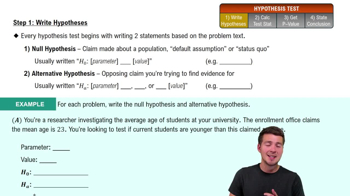
Hypothesis testing is a statistical method used to make decisions about a population based on sample data. It involves formulating a null hypothesis (H0) and an alternative hypothesis (H1). In this case, the null hypothesis states that the mean hat size is at least 7.25, while the alternative suggests it is less than 7.25. The goal is to determine whether the sample data provides sufficient evidence to reject the null hypothesis.
Recommended video:
Guided course
06:21
Step 1: Write Hypotheses

Significance Level (α)

The significance level, denoted as α, is the threshold for determining whether to reject the null hypothesis. In this scenario, α is set at 0.01, meaning there is a 1% risk of concluding that the mean hat size is less than 7.25 when it is actually true. A lower α indicates a stricter criterion for rejecting the null hypothesis, which helps control the probability of making a Type I error.
Recommended video:
03:33
Finding Binomial Probabilities Using TI-84 Example 1

Z-Test for Means

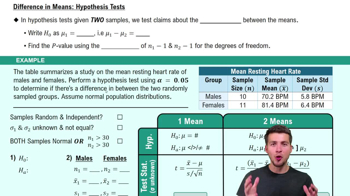
A Z-test for means is used when the population standard deviation is known and the sample size is small (n < 30). It compares the sample mean to the population mean under the null hypothesis. In this case, the Z-test will help determine if the sample mean of 7.15 is significantly lower than the claimed mean of 7.25, using the provided population standard deviation of 0.27 to calculate the Z-score.
Recommended video:
Guided course
08:24
Difference in Means: Hypothesis Tests
Related Practice
Textbook Question

A nonprofit consumer organization says that less than 25% of the televisions the organization rated in a recent year have an overall score of 70 or more. In a random sample of 35 televisions the organization rated in a recent year, 23% have an overall score of 70 or more. At α=0.05, can you support the organization’s claim?

1
views
Textbook Question

n Exercises 1–6, the statement represents a claim. Write its complement and state which is H0 and which is Ha.


μ = 82

Textbook Question

A travel analyst claims the mean daily base price for renting a full-size or less expensive vehicle in Vancouver, British Columbia, is more than \(86. You want to test this claim. In a random sample of 40 full-size or less expensive vehicles available to rent in Vancouver, British Columbia, the mean daily base price is \)93.23. Assume the population standard deviation is \$28.90. At α=0.10, do you have enough evidence to support the analyst’s claim?

Textbook Question

A government agency reports that the mean amount of earnings for full-time workers ages 18 to 24 with a bachelor’s degree in a recent year is \(52,133. In a random sample of 15 full-time workers ages 18 to 24 with a bachelor’s degree, the mean amount of earnings is \)48,400 and the standard deviation is \$6679. At α=0.05, is there enough evidence to reject the claim? Assume the population is normally distributed.

Textbook Question

[APPLET] A weight loss program claims that program participants have a mean weight loss of at least 10.5 pounds after 1 month. The weight losses after 1 month (in pounds) of a random sample of 40 program participants are listed below. At α=0.01, is there enough evidence to reject the program’s claim?


Textbook Question

n Exercises 1–6, the statement represents a claim. Write its complement and state which is H0 and which is Ha.


p ≥ 0.64