
Ch. 6 - Confidence Intervals
Larson - Elementary Statistics: Picturing the World 8th Edition
Larson8th EditionElementary Statistics: Picturing the WorldISBN: 9780137493470Not the one you use?Change textbook
Chapter 6, Problem 6.T.4a

Use the standard normal distribution or the t-distribution to construct the indicated confidence interval for the population mean of each data set. Justify your decision. If neither distribution can be used, explain why. Interpret the results.
a. In a random sample of 40 patients, the mean waiting time at a dentist’s office was 20 minutes and the standard deviation was 7.5 minutes. Construct a 95% confidence interval for the population mean.

Verified step by step guidance
1
Determine which distribution to use: Since the sample size is 40 (greater than 30), the Central Limit Theorem applies, and the sample mean can be approximated by a normal distribution. Additionally, the population standard deviation is not provided, so we use the t-distribution.
Identify the necessary values: The sample mean (\( \bar{x} \)) is 20 minutes, the sample standard deviation (\( s \)) is 7.5 minutes, the sample size (\( n \)) is 40, and the confidence level is 95%.
Find the critical value: For a 95% confidence level and degrees of freedom (\( df = n - 1 = 40 - 1 = 39 \)), use a t-distribution table or software to find the critical value (\( t^* \)).
Calculate the standard error of the mean (SE): Use the formula \( SE = \frac{s}{\sqrt{n}} \), where \( s \) is the sample standard deviation and \( n \) is the sample size.
Construct the confidence interval: Use the formula \( \bar{x} \pm t^* \cdot SE \), where \( \bar{x} \) is the sample mean, \( t^* \) is the critical value, and \( SE \) is the standard error. This will give the lower and upper bounds of the confidence interval.

Verified video answer for a similar problem:

This video solution was recommended by our tutors as helpful for the problem above.
Video duration:
2m
Was this helpful?

Key Concepts

Here are the essential concepts you must grasp in order to answer the question correctly.

Standard Normal Distribution

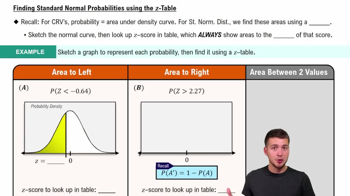
The standard normal distribution is a probability distribution that is symmetric about the mean, with a mean of zero and a standard deviation of one. It is used in statistics to determine probabilities and critical values for hypothesis testing and confidence intervals. When sample sizes are large (typically n > 30), the Central Limit Theorem allows us to use this distribution to approximate the sampling distribution of the sample mean.
Recommended video:
Guided course
09:47
Finding Standard Normal Probabilities using z-Table

t-Distribution

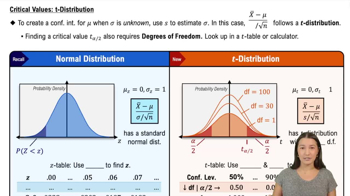
The t-distribution is a type of probability distribution that is used when the sample size is small (n < 30) or when the population standard deviation is unknown. It is similar to the standard normal distribution but has heavier tails, which provides a more accurate estimate of the population mean in these cases. The t-distribution is essential for constructing confidence intervals and conducting hypothesis tests when dealing with small samples.
Recommended video:
05:50
Critical Values: t-Distribution

Confidence Interval

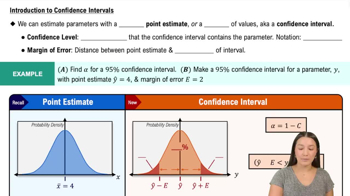
A confidence interval is a range of values, derived from sample statistics, that is likely to contain the population parameter with a specified level of confidence, typically expressed as a percentage (e.g., 95%). It is calculated using the sample mean, the standard deviation, and the appropriate critical value from either the standard normal or t-distribution. Interpreting a confidence interval involves understanding that if the same sampling process were repeated multiple times, a certain percentage of the intervals would contain the true population mean.
Recommended video:
06:33
Introduction to Confidence Intervals
Related Practice
Textbook Question

The data set represents the scores of 12 randomly selected students on the SAT Physics Subject Test. Assume the population test scores are normally distributed and the population standard deviation is 108. (Adapted from The College Board)

b. Construct a 90% confidence interval for the population mean. Interpret the results.

Textbook Question

The data set represents the weights (in pounds) of 10 randomly selected black bears from northeast Pennsylvania. Assume the weights are normally distributed. (Source: Pennsylvania Game Commission)

c. Construct a 99% confidence interval for the population standard deviation. Interpret the results.

Textbook Question

The data set represents the weights (in pounds) of 10 randomly selected black bears from northeast Pennsylvania. Assume the weights are normally distributed. (Source: Pennsylvania Game Commission)

b. Construct a 95% confidence interval for the population mean. Interpret the results.

Textbook Question

The data set represents the scores of 12 randomly selected students on the SAT Physics Subject Test. Assume the population test scores are normally distributed and the population standard deviation is 108. (Adapted from The College Board)

d. Determine the minimum sample size required to be 95% confident that the sample mean test score is within 10 points of the population mean test score.

Textbook Question

Use the standard normal distribution or the t-distribution to construct the indicated confidence interval for the population mean of each data set. Justify your decision. If neither distribution can be used, explain why. Interpret the results.

b. In a random sample of 15 cereal boxes, the mean weight was 11.89 ounces. Assume the weights of the cereal boxes are normally distributed and the population standard deviation is 0.05 ounce. Construct a 90% confidence interval for the population mean.

Textbook Question

In a survey of 2096 U.S. adults, 1740 think football teams of all levels should require players who suffer a head injury to take a set amount of time off from playing to recover. (Adapted from The Harris Poll)

b. Construct a 95% confidence interval for the population proportion. Interpret the results.