
Ch. 6 - Confidence Intervals
Larson - Elementary Statistics: Picturing the World 8th Edition
Larson8th EditionElementary Statistics: Picturing the WorldISBN: 9780137493470Not the one you use?Change textbook
Chapter 6, Problem 6.3.29

Translating Statements In Exercises 29–34, translate the statement into a confidence interval. Approximate the level of confidence.
In a survey of 1502 U.S. adults, 31% said that they use Pinterest. The survey’s margin of error is ±2.9%. (Source: Pew Research Center)

Verified step by step guidance
1
Step 1: Understand the problem. The problem provides a sample proportion (31%), a sample size (1502), and a margin of error (±2.9%). The goal is to translate this information into a confidence interval and approximate the confidence level.
Step 2: Write the formula for a confidence interval for a population proportion. The general form is: p̂ ± ME, where is the sample proportion and ME is the margin of error.
Step 3: Substitute the given values into the formula. Here, p̂ = 0.31 (31% expressed as a decimal) and ME = 0.029 (2.9% expressed as a decimal). The confidence interval is: 0.31 ± 0.029.
Step 4: Calculate the lower and upper bounds of the confidence interval. The lower bound is 0.31 - 0.029, and the upper bound is 0.31 + 0.029. These bounds represent the range of plausible values for the true population proportion.
Step 5: Approximate the confidence level. The margin of error is typically associated with a 95% confidence level unless otherwise stated. Therefore, the confidence interval is likely based on a 95% confidence level.

Verified video answer for a similar problem:

This video solution was recommended by our tutors as helpful for the problem above.
Video duration:
4m
Was this helpful?

Key Concepts

Here are the essential concepts you must grasp in order to answer the question correctly.

Confidence Interval

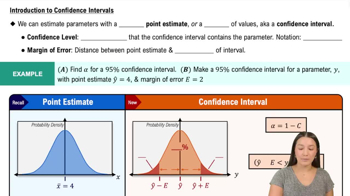
A confidence interval is a range of values, derived from sample statistics, that is likely to contain the true population parameter. It is expressed as an interval estimate, typically calculated as the sample statistic plus or minus a margin of error. For example, if 31% of surveyed adults use Pinterest with a margin of error of ±2.9%, the confidence interval would be from 28.1% to 33.9%.
Recommended video:
06:33
Introduction to Confidence Intervals

Margin of Error

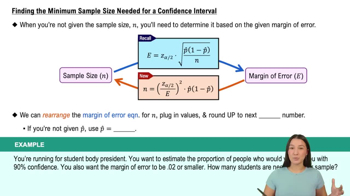
The margin of error quantifies the uncertainty associated with a sample estimate. It indicates the range within which the true population parameter is expected to fall, based on the sample data. In this case, a margin of error of ±2.9% means that the true percentage of U.S. adults using Pinterest could be 2.9% higher or lower than the reported 31%.
Recommended video:
04:08
Finding the Minimum Sample Size Needed for a Confidence Interval

Level of Confidence

The level of confidence reflects the degree of certainty that the confidence interval contains the true population parameter. Common levels of confidence are 90%, 95%, and 99%, with higher levels indicating greater certainty but wider intervals. The level of confidence can be approximated based on the sample size and margin of error, often using standard normal distribution values.
Recommended video:
06:33
Introduction to Confidence Intervals
Related Practice
Textbook Question

Constructing a Confidence Interval In Exercises 31 and 32, use the data set to (c) construct a 98% confidence interval for the population mean.

[APPLET] Earnings The annual earnings (in dollars) of 32 randomly selected intermediate level life insurance underwriters (Adapted from Salary.com)

Textbook Question

Finding Critical Values for χ2 In Exercises 3–8, find the critical values χR2 and χL2 for the level of confidence c and sample size n.

c = 0.98, n = 26

Textbook Question

Translating Statements In Exercises 29–34, translate the statement into a confidence interval. Approximate the level of confidence.

In a survey of 1052 parents of children ages 8–14, 68% say they are willing to get a second or part-time job to pay for their children’s college education, and 42% say they lose sleep worrying about college costs. The survey’s margin of error is ±3%. (Source: T. Rowe Price Group, Inc.)

Textbook Question

In Exercises 9–12, construct the indicated confidence intervals for (a) the population variance and (b) the population standard deviation . Assume the sample is from a normally distributed population.

c = 0.95, s^2 = 11.56, n = 30

Textbook Question

Determining a Minimum Sample Size Determine the minimum sample size required when you want to be 99% confident that the sample mean is within two units of the population mean and σ = 1.4. Assume the population is normally distributed.

Textbook Question

You wish to estimate the mean winning time for Boston Marathon Women’s Open Division champions. The estimate must be within 2 minutes of the population mean. Determine the minimum sample size required to construct a 99% confidence interval for the population mean. Use the population standard deviation from Exercise 1.