Ch. 6 - Confidence Intervals
Larson - Elementary Statistics: Picturing the World 8th Edition
Larson8th EditionElementary Statistics: Picturing the WorldISBN: 9780137493470Not the one you use?Change textbook
Chapter 6, Problem 6.Tech.3b

Since 1935, the Gallup Organization has conducted public opinion polls in the United States and around the world. The table shows the results of Gallup’s World Affairs Poll of 2021, in which 1021 U.S. adults were polled. The remaining percentages not shown in the results are adults who were not sure.
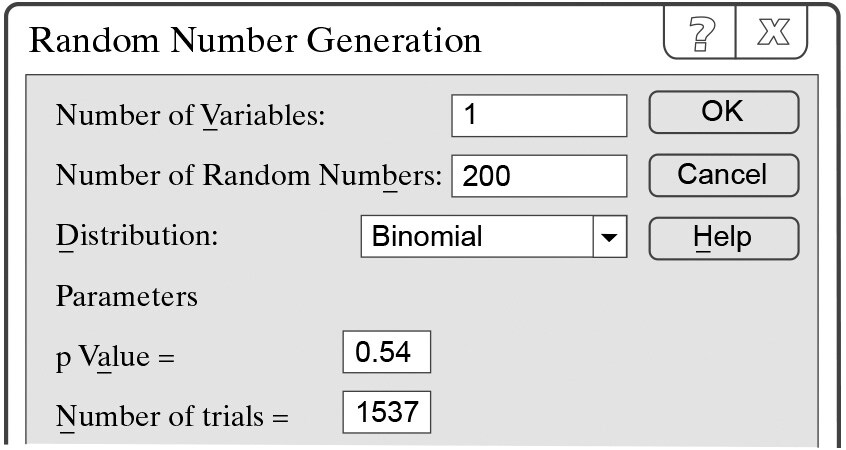
Random number generation interface displaying parameters for a binomial distribution with p-value 0.54 and 1537 trials.
b. What was the greatest value you obtained for p^?

Verified step by step guidance
1
Step 1: Understand the problem. The question asks for the greatest value of p^ (sample proportion) obtained from the Gallup World Affairs Poll of 2021. The image provides parameters for a binomial distribution simulation, which can help analyze probabilities or proportions.
Step 2: Recall the formula for the sample proportion p^: p^ = x/n, where x is the number of successes and n is the total number of trials. In this case, n = 1021 (the number of U.S. adults polled).
Step 3: Analyze the image. The Random Number Generation tool is set to simulate a binomial distribution with p = 0.54 (probability of success) and 1537 trials. However, this simulation is unrelated to the actual poll data, which involves 1021 adults. Focus on the poll data for calculating p^.
Step 4: To find the greatest value of p^, identify the category with the highest number of successes (x) from the poll data. If the data is not explicitly provided, assume the highest percentage corresponds to the greatest p^.
Step 5: Calculate the greatest p^ using the formula p^ = x/n, where x corresponds to the highest percentage of responses multiplied by n (1021). Ensure to convert the percentage into a decimal before multiplying.

Verified video answer for a similar problem:

This video solution was recommended by our tutors as helpful for the problem above.
Video duration:
2m
Was this helpful?

Key Concepts

Here are the essential concepts you must grasp in order to answer the question correctly.

Proportion Estimate (p^)

The proportion estimate, denoted as p^ (p-hat), represents the sample proportion of a certain characteristic in a population. It is calculated by dividing the number of successes (individuals with the characteristic) by the total number of observations in the sample. In the context of polling, p^ indicates the percentage of respondents who expressed a particular opinion.
Recommended video:
Guided course
08:09
Difference in Proportions: Confidence Intervals

Binomial Distribution

The binomial distribution is a probability distribution that describes the number of successes in a fixed number of independent Bernoulli trials, each with the same probability of success. It is characterized by two parameters: the number of trials (n) and the probability of success (p). This distribution is useful for modeling scenarios like polling, where outcomes can be classified as success or failure.
Recommended video:
Guided course
03:28
Mean & Standard Deviation of Binomial Distribution

Random Sampling

Random sampling is a technique used to select a subset of individuals from a larger population, ensuring that each individual has an equal chance of being chosen. This method helps to obtain a representative sample, which is crucial for making valid inferences about the population. In the context of the Gallup poll, random sampling ensures that the opinions of the 1021 U.S. adults reflect the broader population's views.
Recommended video:
04:17
Simple Random Sampling
Related Practice
Textbook Question

Constructing Confidence Intervals In Exercises 13–24, assume the sample is from a normally distributed population and construct the indicated confidence intervals for (a) the population variance σ^2. Interpret the results.

Drive-Thru Times The times (in seconds) spent by a random sample of 28 customers in the drive-thru of a fast-food restaurant have a sample standard deviation of 56.1. Use a 98% level of confidence.

Textbook Question

Fast Food You wish to estimate, with 90% confidence, the population proportion of U.S. families who eat fast food at least once per week. Your estimate must be accurate within 3% of the population proportion.

a. No preliminary estimate is available. Find the minimum sample size needed.

Textbook Question

In a survey of 2096 U.S. adults, 1740 think football teams of all levels should require players who suffer a head injury to take a set amount of time off from playing to recover. (Adapted from The Harris Poll)

a. Find the point estimate for the population proportion.

Textbook Question

Since 1935, the Gallup Organization has conducted public opinion polls in the United States and around the world. The table shows the results of Gallup’s World Affairs Poll of 2021, in which 1021 U.S. adults were polled. The remaining percentages not shown in the results are adults who were not sure.

[IMAGE]

Find the minimum sample size needed to estimate, with 95% confidence, the population proportion of adults who feel that China’s economic power is a critical or an important economic threat to the United States. Your estimate must be accurate within 2% of the population proportion.

1
views
Textbook Question

The data set represents the scores of 12 randomly selected students on the SAT Physics Subject Test. Assume the population test scores are normally distributed and the population standard deviation is 108. (Adapted from The College Board)

c. Would it be unusual for the population mean to be under 575? Explain.

Textbook Question

Since 1935, the Gallup Organization has conducted public opinion polls in the United States and around the world. The table shows the results of Gallup’s World Affairs Poll of 2021, in which 1021 U.S. adults were polled. The remaining percentages not shown in the results are adults who were not sure.

Use technology to find a 95% confidence interval for the population proportion of adults who

a. view foreign trade as an economic opportunity.