Ch. 6 - Confidence Intervals
Larson - Elementary Statistics: Picturing the World 8th Edition
Larson8th EditionElementary Statistics: Picturing the WorldISBN: 9780137493470Not the one you use?Change textbook
Chapter 6, Problem 6.R.11

In Exercises 9–12, find the critical value tc for the level of confidence c and sample size n.
c = 0.98, n = 15

Verified step by step guidance
1
Determine the degrees of freedom (df) for the t-distribution. The formula for degrees of freedom is df = n - 1, where n is the sample size. In this case, df = 15 - 1.
Identify the level of confidence (c). Here, c = 0.98, which means the area in the middle of the t-distribution is 0.98, leaving 0.02 in the two tails combined.
Divide the remaining area (0.02) equally between the two tails to find the area in one tail. This is 0.02 / 2 = 0.01.
Use a t-distribution table or a statistical calculator to find the critical value (tc) that corresponds to the area in one tail (0.01) and the degrees of freedom (df = 14).
Verify the critical value (tc) by ensuring it matches the level of confidence (c = 0.98) and the degrees of freedom (df = 14).

Verified video answer for a similar problem:

This video solution was recommended by our tutors as helpful for the problem above.
Video duration:
1m
Was this helpful?

Key Concepts

Here are the essential concepts you must grasp in order to answer the question correctly.

Critical Value

A critical value is a point on the scale of the test statistic beyond which we reject the null hypothesis. In the context of confidence intervals, it represents the value that separates the confidence level from the tail probabilities. For a given confidence level, it helps determine the margin of error in estimating population parameters.
Recommended video:
05:50
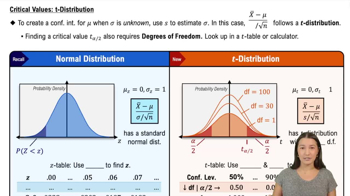
Critical Values: t-Distribution

t-Distribution

The t-distribution is a type of probability distribution that is symmetric and bell-shaped, similar to the normal distribution but with heavier tails. It is used when the sample size is small (typically n < 30) and the population standard deviation is unknown. The t-distribution accounts for the additional uncertainty introduced by estimating the population standard deviation from the sample.
Recommended video:
05:50
Critical Values: t-Distribution

Degrees of Freedom

Degrees of freedom (df) refer to the number of independent values or quantities that can vary in an analysis without violating any constraints. In the context of the t-distribution, degrees of freedom are calculated as n - 1, where n is the sample size. This value is crucial for determining the appropriate critical value from the t-distribution table.
Recommended video:
05:50
Critical Values: t-Distribution
Related Practice
Textbook Question

Determine the minimum sample size required to be 95% confident that the sample mean waking time is within 10 minutes of the population mean waking time. Use the population standard deviation from Exercise 1.

Textbook Question

In Exercises 5 and 6, use the confidence interval to find the margin of error and the sample mean.

(20.75, 24.10)

Textbook Question

In a random sample of 12 senior-level civil engineers, the mean annual earnings were \$133,326 and the standard deviation was \$36,729. Assume the annual earnings are normally distributed and construct a 95% confidence interval for the population mean annual earnings for senior-level civil engineers. Interpret the results. (Adapted from Salary.com)

Textbook Question

[APPLET] The winning times (in hours) for a sample of 20 randomly selected Boston Marathon Women’s Open Division champions from 1980 to 2019 are shown in the table at the left. Assume the population standard deviation is 0.068 hour. (Source: Boston Athletic Association)

d. Does it seem likely that the population mean could be greater than 2.52 hours? Explain.

Textbook Question

You wish to estimate, with 95% confidence, the population proportion of U.S. adults who have taken or planned to take a winter vacation in a recent year. Your estimate must be accurate within 5% of the population proportion.

b. Find the minimum sample size needed, using a prior study that found that 32% of U.S. adults have taken or planned to take a winter vacation in a recent year. (Source: Rasmussen Reports)

Textbook Question

You research the salaries of senior-level civil engineers and find that the population mean is \$131,935. In Exercise 4, does the t-value fall between -t0.95 and t0.95?