

Ch. 5 - Normal Probability Distributions
Larson - Elementary Statistics: Picturing the World 8th Edition
Larson8th EditionElementary Statistics: Picturing the WorldISBN: 9780137493470Not the one you use?Change textbook
Chapter 5, Problem 5.5.14

In Exercises 9–14, write the binomial probability in words. Then, use a continuity correction to convert the binomial probability to a normal distribution probability.


P(55 < x < 60)

Verified step by step guidance
1
Step 1: Understand the problem. The binomial probability P(55 < x < 60) represents the probability of the random variable x falling between 55 and 60 in a binomial distribution. The task is to convert this binomial probability into a normal distribution probability using a continuity correction.
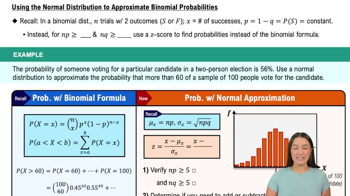
Step 2: Recall the concept of continuity correction. Since the binomial distribution is discrete and the normal distribution is continuous, we apply a continuity correction by adjusting the boundaries of the interval. For P(55 < x < 60), the continuity correction expands the interval to P(54.5 < x < 60.5).
Step 3: Identify the parameters of the binomial distribution. The binomial distribution is defined by two parameters: n (number of trials) and p (probability of success). Ensure you know these values to proceed with the conversion to a normal distribution.
Step 4: Approximate the binomial distribution with a normal distribution. Use the formulas for the mean (μ = n * p) and standard deviation (σ = √(n * p * (1 - p)) of the binomial distribution to define the corresponding normal distribution.
Step 5: Convert the adjusted interval to a z-score. Using the normal distribution parameters (mean and standard deviation), calculate the z-scores for the boundaries 54.5 and 60.5 using the formula z = (x - μ) / σ. Then, find the probability corresponding to these z-scores using the standard normal distribution table or software.

Verified video answer for a similar problem:

This video solution was recommended by our tutors as helpful for the problem above.
Video duration:
2m
Was this helpful?

Key Concepts

Here are the essential concepts you must grasp in order to answer the question correctly.

Binomial Probability

Binomial probability refers to the likelihood of obtaining a fixed number of successes in a fixed number of independent Bernoulli trials, each with the same probability of success. It is calculated using the binomial formula, which incorporates the number of trials, the number of successes, and the probability of success. This concept is essential for understanding scenarios where outcomes are binary, such as success/failure or yes/no.
Recommended video:
Guided course
06:39
Calculating Probabilities in a Binomial Distribution

Normal Distribution

The normal distribution is a continuous probability distribution characterized by its bell-shaped curve, defined by its mean and standard deviation. It is significant in statistics because many phenomena tend to follow this distribution due to the Central Limit Theorem, which states that the sum of a large number of independent random variables will approximate a normal distribution, regardless of the original distribution.
Recommended video:
06:23
Using the Normal Distribution to Approximate Binomial Probabilities

Continuity Correction

Continuity correction is a technique used when approximating a discrete probability distribution, like the binomial distribution, with a continuous distribution, such as the normal distribution. It involves adjusting the discrete values by 0.5 units to account for the fact that the normal distribution is continuous. This correction improves the accuracy of the approximation, especially when the sample size is small or the probability of success is not extreme.
Recommended video:
06:23
Using the Normal Distribution to Approximate Binomial Probabilities
Related Practice
Textbook Question

In Exercises 39 and 40, determine whether the finite correction factor should be used. If so, use it in your calculations when you find the probability.


Old Faithful In a sample of 100 eruptions of the Old Faithful geyser at Yellowstone National Park, the mean interval between eruptions was 129.58 minutes and the standard deviation was 108.54 minutes. A random sample of size 30 is selected from this population. What is the probability that the mean interval between eruptions is between 120 minutes and 140 minutes?

Textbook Question

Conservation About 74% of the residents in a town say that they are making an effort to conserve water or electricity. One hundred ten residents are randomly selected. What is the probability that the sample proportion making an effort to conserve water or electricity is greater than 80%? Interpret your result.

Textbook Question

Computing Probabilities for Normal Distributions In Exercises 1–6, the random variable x is normally distributed with mean mu=174 and standard deviation sigma=20. Find the indicated probability.


P(x > 182)

Textbook Question

Testing a Drug A drug manufacturer claims that a drug cures a rare skin disease 75% of the time. The claim is checked by testing the drug on 100 patients. If at least 70 patients are cured, then this claim will be accepted. Use this information in Exercises 31 and 32.


Find the probability that the claim will be rejected, assuming that the manufacturer’s claim is true.

Textbook Question

In Exercises 5–8, match the binomial probability statement with its corresponding normal distribution probability statement (a)–(d) after a continuity correction.

P(x<109)


a. P(x>109.5)

b. P(x<108.5)

c. P(x<109.5)

d. P(x>108.5)

Textbook Question

Finding Probability In Exercises 41–46, find the probability of z occurring in the shaded region of the standard normal distribution. If convenient, use technology to find the probability.