Ch. 5 - Normal Probability Distributions
Larson - Elementary Statistics: Picturing the World 8th Edition
Larson8th EditionElementary Statistics: Picturing the WorldISBN: 9780137493470Not the one you use?Change textbook
Chapter 5, Problem 5.R.56a

In Exercises 55–60, find the indicated probabilities and interpret the results.


Refer to Exercise 34. A random sample of six days is selected. Find the probability that the mean surface concentration of carbonyl sulfide for the sample is (a) between 5.1 and 15.7 picomoles per liter. Compare your answers with those in Exercise 34.

Verified step by step guidance
1
Step 1: Identify the key information from the problem. The problem involves finding the probability that the sample mean of a random sample of six days falls between 5.1 and 15.7 picomoles per liter. This requires using the sampling distribution of the sample mean. Recall that the mean and standard deviation of the population are needed, as well as the sample size (n = 6). Refer to Exercise 34 for these values.
Step 2: Determine the mean (μ) and standard deviation (σ) of the population from Exercise 34. Use these values to calculate the standard error of the mean (SE), which is given by the formula: SE=σn. Here, n is the sample size (6).
Step 3: Standardize the sample mean values (5.1 and 15.7) to z-scores using the formula: z=-μSE, where x̄ is the sample mean, μ is the population mean, and SE is the standard error calculated in Step 2. Compute the z-scores for both 5.1 and 15.7.
Step 4: Use the standard normal distribution table (or a statistical software) to find the probabilities corresponding to the z-scores obtained in Step 3. Subtract the smaller probability from the larger probability to find the probability that the sample mean is between 5.1 and 15.7.
Step 5: Compare the result with the probabilities obtained in Exercise 34. Note that the probabilities may differ because Exercise 34 likely involved individual data points, while this problem involves the sampling distribution of the sample mean, which has a smaller standard error.

Verified video answer for a similar problem:

This video solution was recommended by our tutors as helpful for the problem above.
Video duration:
10m
Was this helpful?

Key Concepts

Here are the essential concepts you must grasp in order to answer the question correctly.

Sampling Distribution

The sampling distribution is the probability distribution of a statistic (like the sample mean) obtained from a large number of samples drawn from a specific population. It describes how the sample mean varies from sample to sample and is crucial for understanding how to calculate probabilities related to sample means, especially when the sample size is small.
Recommended video:
05:11
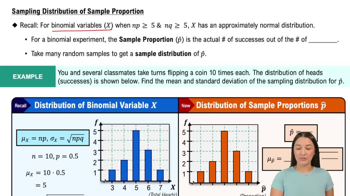
Sampling Distribution of Sample Proportion

Central Limit Theorem (CLT)

The Central Limit Theorem states that, regardless of the population's distribution, the distribution of the sample means will approach a normal distribution as the sample size increases, typically n ≥ 30. This theorem allows statisticians to make inferences about population parameters using sample statistics, particularly when calculating probabilities for sample means.
Recommended video:
Guided course
04:52
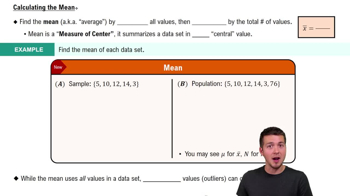
Calculating the Mean

Probability Calculation

Probability calculation involves determining the likelihood of a specific event occurring within a defined sample space. In this context, it requires using the properties of the normal distribution (or approximations thereof) to find the probability that the sample mean falls within a specified range, which is essential for interpreting the results of the sample data.
Recommended video:
Guided course
07:09
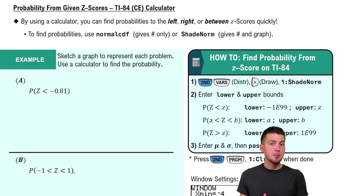
Probability From Given Z-Scores - TI-84 (CE) Calculator
Related Practice
Textbook Question

In Exercises 37–42, use the Standard Normal Table or technology to find the z-score that corresponds to the cumulative area or percentile.


P85
Textbook Question

In Exercises 55–60, find the indicated probabilities and interpret the results.


The mean annual salary for Level 1 actuaries in the United States is about \$72,000. A random sample of 45 Level 1 actuaries is selected. What is the probability that the mean annual salary of the sample is (a) less than \(75,000? Assume sigma = \)11,000.

Textbook Question

In Exercises 55–60, find the indicated probabilities and interpret the results.


Refer to Exercise 33. A random sample of 2 years is selected. Find the probability that the mean amount of greenhouse gases for the sample is (a) less than 5500 MMT CO2 eq. Compare your answers with those in Exercise 33.

Textbook Question

What braking distance represents the first quartile?

Textbook Question

In Exercises 55–60, find the indicated probabilities and interpret the results.


The mean MCAT total score in a recent year is 500.9. A random sample of 32 MCAT total scores is selected. What is the probability that the mean score for the sample is (a) less than 503? Assume sigma=10.6.

Textbook Question

In Exercises 55–60, find the indicated probabilities and interpret the results.


Refer to Exercise 33. A random sample of 2 years is selected. Find the probability that the mean amount of greenhouse gases for the sample is (b) between 6000 and 6500 MMT CO2 eq. Compare your answers with those in Exercise 33.