Ch. 5 - Normal Probability Distributions
Larson - Elementary Statistics: Picturing the World 8th Edition
Larson8th EditionElementary Statistics: Picturing the WorldISBN: 9780137493470Not the one you use?Change textbook
Chapter 5, Problem 5.R.54

In Exercises 53 and 54, find the mean and standard deviation of the indicated sampling distribution of sample means. Then sketch a graph of the sampling distribution.


The test scores for the Law School Admission Test (LSAT) in a recent year are normally distributed, with a mean of 151.88 and a standard deviation of 9.95. Random samples of size 40 are drawn from this population, and the mean of each sample is determined.

Verified step by step guidance
1
Step 1: Understand the problem. We are tasked with finding the mean and standard deviation of the sampling distribution of sample means for LSAT scores. The population mean (μ) is given as 151.88, the population standard deviation (σ) is 9.95, and the sample size (n) is 40.
Step 2: Recall the properties of the sampling distribution of sample means. The mean of the sampling distribution (μ_x̄) is equal to the population mean (μ). Therefore, μ_x̄ = μ = 151.88.
Step 3: Calculate the standard deviation of the sampling distribution of sample means, also known as the standard error (SE). The formula for the standard error is: σ=σn. Substituting the values, σ=9.9540.
Step 4: Sketch the graph of the sampling distribution. Since the population distribution is normal, the sampling distribution of sample means will also be normal. The graph will be a bell-shaped curve centered at the mean (151.88) with a spread determined by the standard error calculated in Step 3.
Step 5: Summarize the results. The mean of the sampling distribution is 151.88, and the standard deviation (standard error) is calculated using the formula in Step 3. The graph is a normal distribution centered at 151.88 with the calculated standard error as its spread.

Verified video answer for a similar problem:

This video solution was recommended by our tutors as helpful for the problem above.
Video duration:
1m
Was this helpful?

Key Concepts

Here are the essential concepts you must grasp in order to answer the question correctly.

Sampling Distribution of Sample Means

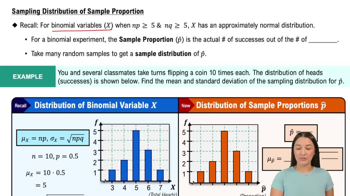
The sampling distribution of sample means refers to the distribution of the means of all possible random samples of a specific size drawn from a population. According to the Central Limit Theorem, this distribution will tend to be normally distributed, regardless of the population's distribution, as the sample size increases. It is characterized by its mean, which equals the population mean, and its standard deviation, known as the standard error.
Recommended video:
05:11
Sampling Distribution of Sample Proportion

Mean

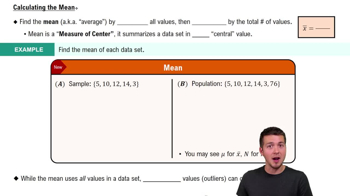
The mean is a measure of central tendency that represents the average of a set of values. In the context of sampling distributions, the mean of the sampling distribution of sample means is equal to the population mean. It provides a summary measure that indicates where the center of the data lies, making it essential for understanding the overall trend of the sample data.
Recommended video:
Guided course
04:52
Calculating the Mean

Standard Deviation and Standard Error

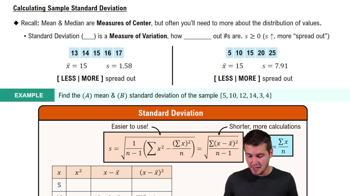
Standard deviation is a statistic that quantifies the amount of variation or dispersion in a set of values. In sampling distributions, the standard error is the standard deviation of the sampling distribution of sample means, calculated as the population standard deviation divided by the square root of the sample size. It indicates how much the sample means are expected to vary from the population mean, providing insight into the reliability of the sample estimates.
Recommended video:
Guided course
08:45
Calculating Standard Deviation
Related Practice
Textbook Question

In Exercises 69 and 70, determine whether you can use a normal distribution to approximate the binomial distribution. If you can, use the normal distribution to approximate the indicated probabilities and sketch their graphs. If you cannot, explain why and use a binomial distribution to find the indicated probabilities.


A survey of U.S. adults found that 72% used a mobile device to manage their bank account at least once in the previous month. You randomly select 70 U.S. adults and ask whether they used a mobile device to manage their bank account at least once in the previous month. Find the probability that the number who have done so is (c) greater than 60.

Textbook Question

The random variable x is normally distributed with the given parameters. Find each probability.

b. μ = 87, σ ≈ 19, P(x > 40.5)

Textbook Question

In Exercises 51 and 52, a population and sample size are given. (a) Find the mean and standard deviation of the population.

The goals scored in a season by the four starting defenders on a soccer team are 1, 2, 0, and 3. Use a sample size of 2.

Textbook Question

The random variable x is normally distributed with the given parameters. Find each probability.


c. μ = 5.5, σ ≈ 0.08, P(5.36 < x < 5.64)

Textbook Question

In Exercises 55–60, find the indicated probabilities and interpret the results.


The mean ACT composite score in a recent year is 20.7. A random sample of 36 ACT composite scores is selected. What is the probability that the mean score for the sample is (a) less than 22, (b) greater than 23, and (c) between 20 and 21.5? Assume sigma=5.9.

Textbook Question

In a standardized IQ test, scores are normally distributed, with a mean score of 100 and a standardized deviation of 15. Use this information in Exercises 3–10. (Adapted from 123test)

What is the highest score that would still place a person in the bottom 10% of the scores?