Ch. 5 - Normal Probability Distributions
Larson - Elementary Statistics: Picturing the World 8th Edition
Larson8th EditionElementary Statistics: Picturing the WorldISBN: 9780137493470Not the one you use?Change textbook
Chapter 5, Problem 5.T.2b

In Exercises 2–4, the random variable x is normally distributed with mean mu= 18 and standard deviation sigma 7.6


Find each probability.


b. P(0 < x < 5)

Verified step by step guidance
1
Step 1: Understand the problem. The random variable x is normally distributed with a mean (μ) of 18 and a standard deviation (σ) of 7.6. We are tasked with finding the probability that x lies between 0 and 5, i.e., P(0 < x < 5).
Step 2: Standardize the values of x = 0 and x = 5 using the z-score formula: z = (x - μ) / σ. For x = 0, calculate z₀ = (0 - 18) / 7.6. For x = 5, calculate z₅ = (5 - 18) / 7.6.
Step 3: Use the standard normal distribution table (or a calculator) to find the cumulative probabilities corresponding to z₀ and z₅. These probabilities represent the areas under the standard normal curve to the left of z₀ and z₅, respectively.
Step 4: To find P(0 < x < 5), subtract the cumulative probability for z₀ from the cumulative probability for z₅. Mathematically, P(0 < x < 5) = P(z₅) - P(z₀).
Step 5: Interpret the result. The value obtained represents the probability that the random variable x falls between 0 and 5 in the given normal distribution.

Verified video answer for a similar problem:

This video solution was recommended by our tutors as helpful for the problem above.
Video duration:
6m
Was this helpful?

Key Concepts

Here are the essential concepts you must grasp in order to answer the question correctly.

Normal Distribution

The normal distribution is a continuous probability distribution characterized by its bell-shaped curve, defined by its mean (mu) and standard deviation (sigma). In this distribution, approximately 68% of the data falls within one standard deviation of the mean, and about 95% falls within two standard deviations. Understanding this distribution is crucial for calculating probabilities related to normally distributed random variables.
Recommended video:
06:23
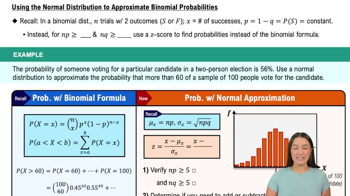
Using the Normal Distribution to Approximate Binomial Probabilities

Z-scores

A Z-score represents the number of standard deviations a data point is from the mean of a distribution. It is calculated using the formula Z = (X - mu) / sigma, where X is the value of interest, mu is the mean, and sigma is the standard deviation. Z-scores are essential for finding probabilities in a normal distribution, as they allow us to use standard normal distribution tables or software to determine the likelihood of a given range of values.
Recommended video:
Guided course
06:31
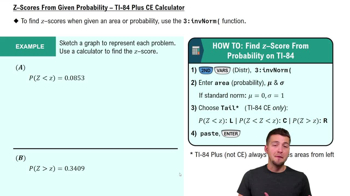
Z-Scores From Given Probability - TI-84 (CE) Calculator

Probability Calculation

Probability calculation in statistics involves determining the likelihood of a specific event occurring within a defined range. For normally distributed variables, this often requires converting the values into Z-scores and then using the standard normal distribution to find the corresponding probabilities. In the context of the question, calculating P(0 < x < 5) involves finding the probabilities associated with the Z-scores for 0 and 5 and then determining the area under the curve between these two points.
Recommended video:
Guided course
07:09
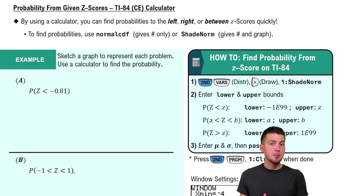
Probability From Given Z-Scores - TI-84 (CE) Calculator
Related Practice
Textbook Question

A certain stock's daily percent return on Fridays has a mean of 3.12% and a standard deviation of 41.25%. If random samples of 40 days are selected and the mean return for each sample is calculated, what is the probability that a sample mean is greater than 17%?

Textbook Question

The per capita disposable income for residents of a U.S. city in a recent year is normally distributed, with a mean of about \$44,000 and a standard deviation of about \(2450. Use this information in Exercises 7–10.


Out of 800 residents, about how many would you expect to have a disposable income of between \)40,000 and \$42,000?

Textbook Question

In Exercises 5 and 6, determine whether you can use a normal distribution to approximate the binomial distribution. If you can, use the normal distribution to approximate the indicated probabilities and sketch their graphs. If you cannot, explain why and use a binomial distribution to find the indicated probabilities.


A survey of U.S. undergraduates found that 37% of those attending in-state colleges would prefer to take a job in a different state after graduation. You randomly select 18 U.S. undergraduates attending in-state colleges. Find the probability that the number who would prefer to take a job in a different state after graduation is (a) exactly 7. Identify any unusual events. Explain.
Textbook Question

In Exercises 5 and 6, determine whether you can use a normal distribution to approximate the binomial distribution. If you can, use the normal distribution to approximate the indicated probabilities and sketch their graphs. If you cannot, explain why and use a binomial distribution to find the indicated probabilities.


A survey of U.S. undergraduates found that 37% of those attending in-state colleges would prefer to take a job in a different state after graduation. You randomly select 18 U.S. undergraduates attending in-state colleges. Find the probability that the number who would prefer to take a job in a different state after graduation is (b) less than 5. Identify any unusual events. Explain.

Textbook Question

In Exercises 2–4, the random variable x is normally distributed with mean mu= 18 and standard deviation sigma 7.6


Find the value of x that has 88.3% of the distribution’s area to its left.

Textbook Question

During a recent period of one year, the mean percent increase in value on Wednesdays of the cryptocurrency Dogecoin was 7.46%, with a standard deviation of 53.47%. Random samples of size 50 are drawn from this population and the mean of each sample is determined. (Source: Crypto Indicators)


c. What is the probability that the mean percent increase for a given sample is between −10% and 30%?