Ch. 5 - Normal Probability Distributions
Larson - Elementary Statistics: Picturing the World 8th Edition
Larson8th EditionElementary Statistics: Picturing the WorldISBN: 9780137493470Not the one you use?Change textbook
Chapter 5, Problem 5.1.1

Given the mean of a normal distribution, how can you find the median?

Verified step by step guidance
1
Understand the properties of a normal distribution: A normal distribution is symmetric about its mean, and the mean, median, and mode are all equal in a perfectly normal distribution.
Recall the definition of the median: The median is the value that separates the data into two equal halves, with 50% of the data below it and 50% above it.
Recognize that in a normal distribution, due to its symmetry, the point that divides the data into two equal halves is the same as the mean.
Conclude that for a normal distribution, the median is equal to the mean because of the symmetry of the distribution.
To find the median, simply use the given mean value, as they are identical in a normal distribution.

Verified video answer for a similar problem:

This video solution was recommended by our tutors as helpful for the problem above.
Video duration:
41s
Was this helpful?

Key Concepts

Here are the essential concepts you must grasp in order to answer the question correctly.

Normal Distribution

A normal distribution is a continuous probability distribution characterized by its bell-shaped curve, defined by its mean and standard deviation. In a normal distribution, the mean, median, and mode are all equal, which means that the data is symmetrically distributed around the mean.
Recommended video:
06:23
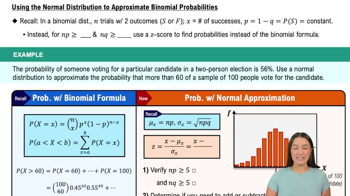
Using the Normal Distribution to Approximate Binomial Probabilities

Mean

The mean is the average of a set of values, calculated by summing all the values and dividing by the number of values. In the context of a normal distribution, the mean serves as the central point of the distribution, indicating where the highest concentration of data points lies.
Recommended video:
Guided course
04:52
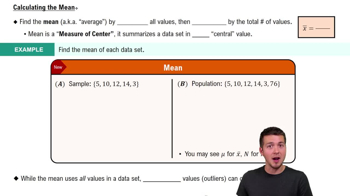
Calculating the Mean

Median

The median is the middle value of a dataset when it is ordered from least to greatest. For a normal distribution, the median is equal to the mean, as the distribution is symmetric. This property allows one to easily determine the median if the mean is known.
Recommended video:
Guided course
03:26
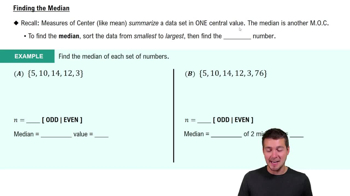
Calculating the Median
Related Practice
Textbook Question

True or False? In Exercises 5–8, determine whether the statement is true or false. If it is false, rewrite it as a true statement.


As the sample size increases, the mean of the distribution of sample means increases.
Textbook Question

"Getting Physical The figure shows the results of a survey of U.S. adults ages 18 to 29 who were asked whether they participated in a sport. In the survey, 48% of the men and 23% of the women said they participate in sports. The most common sports are shown below. Use this information in Exercises 29 and 30.

You randomly select 250 U.S. men ages 18 to 29 and ask them whether they participate in at least one sport. You find that 80% say no. How likely is this result? Do you think this sample is a good one? Explain your reasoning."

Textbook Question

Finding a z-Score In Exercises 1–16, use the Standard Normal Table or technology to find the z-score that corresponds to the cumulative area or percentile.


P1.5

Textbook Question

Finding Probabilities In Exercises 15–18, the population mean and standard deviation are given. Find the indicated probability and determine whether the given sample mean would be considered unusual.


For a random sample of n=64, find the probability of a sample mean being less than 24.3 when Mu=24 and sigma=1.25.

Textbook Question

Which Is More Likely? Assume that the fertility rates in Exercise 32 are normally distributed. Are you more likely to randomly select a state with a fertility rate of less than 65 or to randomly select a sample of 15 states in which the mean of the state fertility rates is less than 65? Explain.

Textbook Question

Finding Probabilities In Exercises 15–18, the population mean and standard deviation are given. Find the indicated probability and determine whether the given sample mean would be considered unusual.


For a random sample of n=45, find the probability of a sample mean being greater than 551 when mu=550 and sigma=3.7.