Ch. 5 - Normal Probability Distributions
Larson - Elementary Statistics: Picturing the World 8th Edition
Larson8th EditionElementary Statistics: Picturing the WorldISBN: 9780137493470Not the one you use?Change textbook
Chapter 5, Problem 5.CR.12c

Forty-nine percent of U.S. adults think that human activity such as burning fossil fuels contributes a great deal to climate change. You randomly select 25 U.S. adults. Find the probability that the number who think that human activity contributes a great deal to climate change is (c) less than two. (d) Are any of these events unusual? Explain your reasoning.

Verified step by step guidance
1
Step 1: Identify the type of probability distribution. Since the problem involves a fixed number of trials (25 adults), each with two possible outcomes (think human activity contributes a great deal or not), and the probability of success (49%) is constant, this is a binomial distribution. The number of trials (n) is 25, and the probability of success (p) is 0.49.
Step 2: Define the random variable X. Let X represent the number of adults who think human activity contributes a great deal to climate change. The goal is to find P(X < 2), which is the probability that fewer than 2 adults think this way.
Step 3: Use the binomial probability formula to calculate P(X = 0) and P(X = 1). The formula is P(X = k) = (n choose k) * p^k * (1-p)^(n-k), where 'n choose k' is the binomial coefficient. For X = 0 and X = 1, substitute the values of n, k, and p into the formula.
Step 4: Add the probabilities for P(X = 0) and P(X = 1) to find P(X < 2). Since 'less than 2' includes both X = 0 and X = 1, sum the probabilities calculated in the previous step.
Step 5: To determine if the event is unusual, compare the probability P(X < 2) to a threshold (typically 0.05). If P(X < 2) is less than 0.05, the event is considered unusual. Explain your reasoning based on this comparison.

Verified video answer for a similar problem:

This video solution was recommended by our tutors as helpful for the problem above.
Video duration:
4m
Was this helpful?

Key Concepts

Here are the essential concepts you must grasp in order to answer the question correctly.

Binomial Distribution

The binomial distribution models the number of successes in a fixed number of independent Bernoulli trials, each with the same probability of success. In this context, each selected adult either believes that human activity contributes to climate change (success) or does not (failure). The parameters of the distribution are the number of trials (n = 25) and the probability of success (p = 0.49).
Recommended video:
Guided course
03:28
Mean & Standard Deviation of Binomial Distribution

Probability Calculation

To find the probability of a specific number of successes in a binomial distribution, we use the binomial probability formula: P(X = k) = (n choose k) * p^k * (1-p)^(n-k). For this question, we need to calculate the probability of fewer than two adults (k < 2) believing in the contribution of human activity to climate change, which involves summing the probabilities for k = 0 and k = 1.
Recommended video:
Guided course
07:09
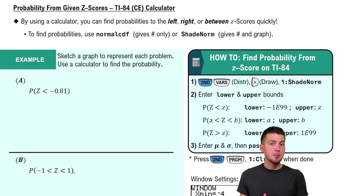
Probability From Given Z-Scores - TI-84 (CE) Calculator

Unusual Events

An event is considered unusual if its probability is less than 5%. After calculating the probabilities for the number of adults who believe in the contribution of human activity to climate change, we can assess whether the events of having fewer than two supporters are unusual. This involves comparing the calculated probabilities to the 5% threshold to determine if they fall into the category of unusual events.
Recommended video:
05:54
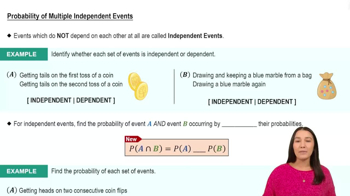
Probability of Multiple Independent Events