Ch. 5 - Normal Probability Distributions
Larson - Elementary Statistics: Picturing the World 8th Edition
Larson8th EditionElementary Statistics: Picturing the WorldISBN: 9780137493470Not the one you use?Change textbook
Chapter 5, Problem 5.4.31

Finding Probabilities for Sampling Distributions In Exercises 29–32, find the indicated probability and interpret the results.


Asthma Prevalence by State The mean percent of asthma prevalence of the 50 U.S. states is 9.51%. A random sample of 30 states is selected. What is the probability that the mean percent of asthma prevalence for the sample is greater than 10%? Assume sigma=1.17%

Verified step by step guidance
1
Step 1: Identify the given information. The population mean (μ) is 9.51%, the population standard deviation (σ) is 1.17%, the sample size (n) is 30, and we are tasked with finding the probability that the sample mean (x̄) is greater than 10%.
Step 2: Calculate the standard error of the mean (SE). The formula for the standard error is SE = σ / √n. Substitute the given values into the formula: SE = 1.17% / √30.
Step 3: Standardize the sample mean to find the z-score. The formula for the z-score is z = (x̄ - μ) / SE. Substitute the values: z = (10% - 9.51%) / SE, where SE is the value calculated in Step 2.
Step 4: Use the z-score to find the probability. Look up the z-score in the standard normal distribution table or use statistical software to find the cumulative probability corresponding to the z-score. Since we are looking for the probability that the sample mean is greater than 10%, calculate 1 - P(Z ≤ z).
Step 5: Interpret the result. The final probability represents the likelihood that the mean percent of asthma prevalence for a random sample of 30 states is greater than 10%.

Verified video answer for a similar problem:

This video solution was recommended by our tutors as helpful for the problem above.
Video duration:
3m
Was this helpful?

Key Concepts

Here are the essential concepts you must grasp in order to answer the question correctly.

Sampling Distribution

A sampling distribution is the probability distribution of a statistic obtained by selecting random samples from a population. In this context, it refers to the distribution of sample means for the asthma prevalence across different samples of states. Understanding this concept is crucial for determining how sample means behave and how they relate to the population mean.
Recommended video:
05:11
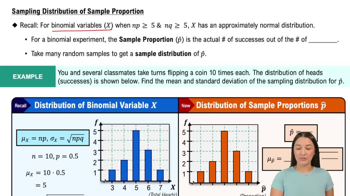
Sampling Distribution of Sample Proportion

Central Limit Theorem (CLT)

The Central Limit Theorem states that the distribution of the sample means will approach a normal distribution as the sample size increases, regardless of the population's distribution, provided the sample size is sufficiently large (typically n ≥ 30). This theorem allows us to use normal probability calculations to find the likelihood of the sample mean exceeding a certain value, such as 10% in this case.
Recommended video:
Guided course
04:52
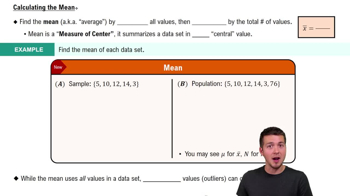
Calculating the Mean

Z-Score

A Z-score is a statistical measurement that describes a value's relationship to the mean of a group of values, expressed in terms of standard deviations. In this problem, calculating the Z-score will help determine how many standard deviations the sample mean of 10% is from the population mean of 9.51%, allowing us to find the corresponding probability using the standard normal distribution.
Recommended video:
Guided course
06:31
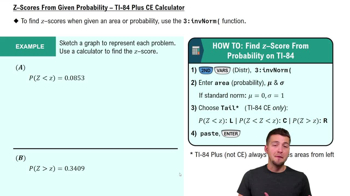
Z-Scores From Given Probability - TI-84 (CE) Calculator