Ch. 5 - Normal Probability Distributions
Larson - Elementary Statistics: Picturing the World 8th Edition
Larson8th EditionElementary Statistics: Picturing the WorldISBN: 9780137493470Not the one you use?Change textbook
Chapter 5, Problem 5.1.29

Finding Area
In Exercises 23–36, find the indicated area under the standard normal curve. If convenient, use technology to find the area.


To the right of z= -0.355

Verified step by step guidance
1
Step 1: Understand the problem. The goal is to find the area under the standard normal curve to the right of z = -0.355. The standard normal curve is symmetric, with a mean of 0 and a standard deviation of 1.
Step 2: Recall that the total area under the standard normal curve is 1. The area to the right of a given z-score can be found using the cumulative distribution function (CDF) of the standard normal distribution.
Step 3: Use the formula for the cumulative area to the left of z, which is given by P(Z ≤ z). For z = -0.355, find the cumulative area to the left of this z-score using a z-table or statistical software.
Step 4: Subtract the cumulative area to the left of z = -0.355 from 1 to find the area to the right. Mathematically, this is expressed as P(Z > -0.355) = 1 - P(Z ≤ -0.355).
Step 5: If using technology, input z = -0.355 into a statistical calculator or software to directly compute the area to the right. Alternatively, use a z-table to find P(Z ≤ -0.355), then subtract it from 1 as described in Step 4.

Verified video answer for a similar problem:

This video solution was recommended by our tutors as helpful for the problem above.
Video duration:
2m
Was this helpful?

Key Concepts

Here are the essential concepts you must grasp in order to answer the question correctly.

Standard Normal Distribution

The standard normal distribution is a special normal distribution with a mean of 0 and a standard deviation of 1. It is used to describe how data is distributed in a standardized way, allowing for comparison across different datasets. The z-score represents the number of standard deviations a data point is from the mean, facilitating the calculation of probabilities and areas under the curve.
Recommended video:
Guided course
09:47
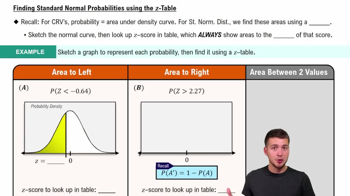
Finding Standard Normal Probabilities using z-Table

Z-Score

A z-score indicates how many standard deviations an element is from the mean of a distribution. It is calculated by subtracting the mean from the value and then dividing by the standard deviation. In the context of the standard normal distribution, a z-score of -0.355 means the value is 0.355 standard deviations below the mean, which is essential for determining the area to the right of this z-score.
Recommended video:
Guided course
06:31
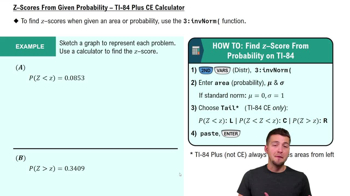
Z-Scores From Given Probability - TI-84 (CE) Calculator

Area Under the Curve

The area under the curve of a probability distribution represents the likelihood of a random variable falling within a particular range. For the standard normal distribution, this area can be found using z-tables or technology, such as statistical software or calculators. In this case, finding the area to the right of z = -0.355 involves calculating the probability that a value is greater than this z-score.
Recommended video:
Guided course
08:50
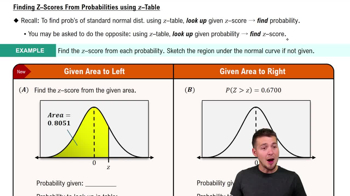
Z-Scores from Probabilities
Related Practice
Textbook Question

Testing a Drug A drug manufacturer claims that a drug cures a rare skin disease 75% of the time. The claim is checked by testing the drug on 100 patients. If at least 70 patients are cured, then this claim will be accepted. Use this information in Exercises 31 and 32.


Find the probability that the claim will be rejected, assuming that the manufacturer’s claim is true.

Textbook Question

In Exercises 5–8, match the binomial probability statement with its corresponding normal distribution probability statement (a)–(d) after a continuity correction.

P(x<109)


a. P(x>109.5)

b. P(x<108.5)

c. P(x<109.5)

d. P(x>108.5)

Textbook Question

Finding Probability In Exercises 41–46, find the probability of z occurring in the shaded region of the standard normal distribution. If convenient, use technology to find the probability.


Textbook Question

Milk Containers A machine is set to fill milk containers with a mean of 64 ounces and a standard deviation of 0.11 ounce. A random sample of 40 containers has a mean of 64.05 ounces. The machine needs to be reset when the mean of a random sample is unusual. Does the machine need to be reset? Explain.

1
views
Textbook Question

In Exercises 9–14, write the binomial probability in words. Then, use a continuity correction to convert the binomial probability to a normal distribution probability.


P(x ≥ 110)

Textbook Question

In Exercises 1–4, a population has a mean mu and a standard deviation sigma. Find the mean and standard deviation of the sampling distribution of sample means with sample size n.


Mu = 1275, sigma =6, n = 1000