Ch. 5 - Normal Probability Distributions
Larson - Elementary Statistics: Picturing the World 8th Edition
Larson8th EditionElementary Statistics: Picturing the WorldISBN: 9780137493470Not the one you use?Change textbook
Chapter 5, Problem 5.3.6

Finding a z-Score In Exercises 1–16, use the Standard Normal Table or technology to find the z-score that corresponds to the cumulative area or percentile.


0.94

Verified step by step guidance
1
Step 1: Understand the problem. You are tasked with finding the z-score that corresponds to a cumulative area (or percentile) of 0.94 under the standard normal distribution. The cumulative area represents the probability that a value is less than or equal to the z-score.
Step 2: Recall that the standard normal distribution is symmetric with a mean of 0 and a standard deviation of 1. The cumulative area of 0.94 means that 94% of the data lies to the left of the z-score.
Step 3: Use the Standard Normal Table (also called the z-table) or technology (such as a statistical calculator or software) to find the z-score. Locate the cumulative area of 0.94 in the table, or use the inverse cumulative distribution function (often denoted as invNorm or similar) in technology.
Step 4: If using the z-table, find the closest value to 0.94 in the body of the table. Then, identify the corresponding z-score by combining the row and column headers. If using technology, input the cumulative area (0.94) into the inverse cumulative function to directly obtain the z-score.
Step 5: Interpret the result. The z-score you find represents the number of standard deviations above the mean where 94% of the data lies to the left. This z-score is positive because 0.94 is greater than 0.5, indicating it is on the right side of the mean.

Verified video answer for a similar problem:

This video solution was recommended by our tutors as helpful for the problem above.
Video duration:
3m
Was this helpful?

Key Concepts

Here are the essential concepts you must grasp in order to answer the question correctly.

Z-Score

A z-score is a statistical measurement that describes a value's relationship to the mean of a group of values. It indicates how many standard deviations an element is from the mean. A positive z-score means the value is above the mean, while a negative z-score indicates it is below. Z-scores are essential for standardizing scores on different scales, allowing for comparison across different datasets.
Recommended video:
Guided course
06:31
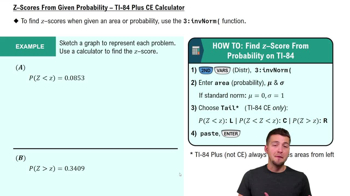
Z-Scores From Given Probability - TI-84 (CE) Calculator

Standard Normal Distribution

The standard normal distribution is a special case of the normal distribution where the mean is 0 and the standard deviation is 1. It is symmetric and bell-shaped, representing the distribution of many natural phenomena. The area under the curve corresponds to probabilities, and z-scores can be used to find the cumulative area to the left of a given value, which is crucial for determining percentiles.
Recommended video:
Guided course
09:47
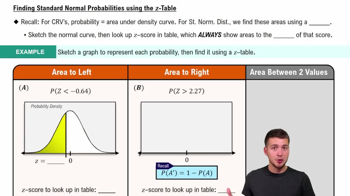
Finding Standard Normal Probabilities using z-Table

Cumulative Area

Cumulative area refers to the total area under the curve of a probability distribution up to a certain point. In the context of the standard normal distribution, it represents the probability that a randomly selected score will be less than or equal to a specific z-score. This concept is vital for interpreting z-scores in terms of percentiles, allowing for the assessment of how a particular score compares to the overall distribution.
Recommended video:
Guided course
03:50
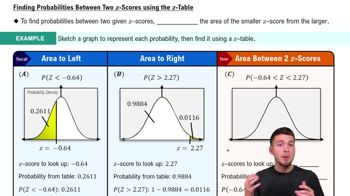
Probabilities Between Two Values
Related Practice
Textbook Question

In Exercises 39 and 40, determine whether the finite correction factor should be used. If so, use it in your calculations when you find the probability.


Parking Infractions In a sample of 1000 fines issued by the City of Toronto for parking infractions in September of 2020, the mean fine was \$49.83 and the standard deviation was \$52.15. A random sample of size 60 is selected from this population. What is the probability that the mean fine is less than \$40?

Textbook Question

Draw two normal curves that have the same mean but different standard deviations. Describe the similarities and differences.

Textbook Question

True or False? In Exercises 5–8, determine whether the statement is true or false. If it is false, rewrite it as a true statement.


A sampling distribution is normal only when the population is normal.

Textbook Question

Finding a z-Score In Exercises 1–16, use the Standard Normal Table or technology to find the z-score that corresponds to the cumulative area or percentile.


P33

Textbook Question

True or False? In Exercises 5–8, determine whether the statement is true or false. If it is false, rewrite it as a true statement.


If the sample size is at least 30, then you can use z-scores to determine the probability that a sample mean falls in a given interval of the sampling distribution.

Textbook Question

Graphical Analysis In Exercises 11–16, determine whether the graph could represent a variable with a normal distribution. Explain your reasoning. If the graph appears to represent a normal distribution, estimate the mean and standard deviation.