Ch. 5 - Normal Probability Distributions
Larson - Elementary Statistics: Picturing the World 8th Edition
Larson8th EditionElementary Statistics: Picturing the WorldISBN: 9780137493470Not the one you use?Change textbook
Chapter 5, Problem 5.R.35

Determine whether any of the events in Exercise 33 are unusual. Explain your reasoning.

Verified step by step guidance
1
Identify the events mentioned in Exercise 33 and determine their probabilities. An event is considered unusual if its probability is very low, typically less than 0.05 (5%).
Calculate the probability of each event using the given data or formulas. For example, if the problem involves binomial probabilities, use the binomial probability formula: P(X=k)=n!k!(n-k)!pk(1-p)n-k.
Compare the calculated probabilities of each event to the threshold of 0.05. If the probability of an event is less than 0.05, it is considered unusual.
Explain why an event is unusual based on its low probability. For example, you might say, 'This event is unusual because its probability is less than 0.05, indicating it is unlikely to occur under normal circumstances.'
Summarize your findings by listing which events are unusual and which are not, along with their respective probabilities and reasoning.

Verified video answer for a similar problem:

This video solution was recommended by our tutors as helpful for the problem above.
Video duration:
2m
Was this helpful?

Key Concepts

Here are the essential concepts you must grasp in order to answer the question correctly.

Unusual Events

In statistics, an event is considered unusual if its probability of occurrence is significantly low, typically defined as less than 5%. This threshold helps to identify events that deviate from what is expected under normal circumstances, prompting further investigation or consideration.
Recommended video:
05:54
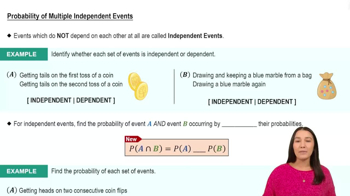
Probability of Multiple Independent Events

Probability

Probability is a measure of the likelihood that a particular event will occur, expressed as a number between 0 and 1. Understanding probability is essential for determining whether an event is unusual, as it quantifies how often we expect an event to happen based on historical data or theoretical models.
Recommended video:
5:37
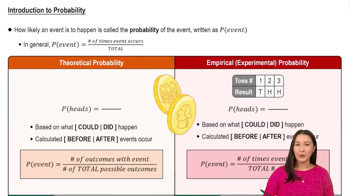
Introduction to Probability

Statistical Significance

Statistical significance refers to the likelihood that a result or relationship observed in data is not due to random chance. In the context of unusual events, determining statistical significance helps to assess whether the occurrence of an event is noteworthy and warrants further analysis or action.
Recommended video:
Guided course
05:53
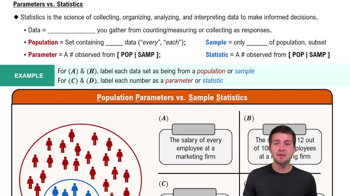
Parameters vs. Statistics
Related Practice
Textbook Question

In Exercises 55–60, find the indicated probabilities and interpret the results.


Refer to Exercise 33. A random sample of 2 years is selected. Find the probability that the mean amount of greenhouse gases for the sample is (c) greater than 5900 MMT CO2 eq. Compare your answers with those in Exercise 33.

Textbook Question

In Exercises 55–60, find the indicated probabilities and interpret the results.


The mean MCAT total score in a recent year is 500.9. A random sample of 32 MCAT total scores is selected. What is the probability that the mean score for the sample is (b) more than 502? Assume sigma=10.6.

Textbook Question

In Exercises 63–68, write the binomial probability in words. Then, use a continuity correction to convert the binomial probability to a normal distribution probability.


P(x < 60)

Textbook Question

In Exercises 55–60, find the indicated probabilities and interpret the results.


The mean ACT composite score in a recent year is 20.7. A random sample of 36 ACT composite scores is selected. What is the probability that the mean score for the sample is (c) between 20 and 21.5? Assume σ=5.9.

Textbook Question

In Exercises 53 and 54, find the mean and standard deviation of the indicated sampling distribution of sample means. Then sketch a graph of the sampling distribution.


The population densities in people per square mile in the 50 U.S. states have a mean of 199.6 and a standard deviation of 265.4. Random samples of size 35 are drawn from this population, and the mean of each sample is determined.

Textbook Question

In Exercises 69 and 70, determine whether you can use a normal distribution to approximate the binomial distribution. If you can, use the normal distribution to approximate the indicated probabilities and sketch their graphs. If you cannot, explain why and use a binomial distribution to find the indicated probabilities.


A survey of U.S. adults found that 72% used a mobile device to manage their bank account at least once in the previous month. You randomly select 70 U.S. adults and ask whether they used a mobile device to manage their bank account at least once in the previous month. Find the probability that the number who have done so is (a) at most 40.