Ch. 5 - Normal Probability Distributions
Larson - Elementary Statistics: Picturing the World 8th Edition
Larson8th EditionElementary Statistics: Picturing the WorldISBN: 9780137493470Not the one you use?Change textbook
Chapter 5, Problem 5.5.26a

Approximating Binomial Probabilities In Exercises 19–26, determine whether you can use a normal distribution to approximate the binomial distribution. If you can, use the normal distribution to approximate the indicated probabilities and sketch their graphs. If you cannot, explain why and use a binomial distribution to find the indicated probabilities. Identify any unusual events. Explain.


Advancing Research In a survey of U.S. adults, 77% said are willing to share their personal health information to advance medical research. You randomly select 500 U.S. adults. Find the probability that the number who are willing to share their personal health information to advance medical research is (a) at most 400

Verified step by step guidance
1
Step 1: Verify if the normal approximation to the binomial distribution can be used. Check the conditions: (1) The sample size (n) should be large, and (2) both np and n(1-p) should be greater than or equal to 5. Here, n = 500 and p = 0.77. Calculate np = 500 * 0.77 and n(1-p) = 500 * (1 - 0.77).
Step 2: If the conditions are satisfied, approximate the binomial distribution using a normal distribution. The mean (μ) and standard deviation (σ) of the binomial distribution are given by μ = np and σ = sqrt(np(1-p)). Calculate these values.
Step 3: Apply the continuity correction for the normal approximation. Since the problem asks for 'at most 400,' adjust the value to 400.5 to include the probability for 400 in the normal distribution.
Step 4: Standardize the value using the z-score formula: z = (x - μ) / σ, where x is the adjusted value (400.5), μ is the mean, and σ is the standard deviation. Compute the z-score.
Step 5: Use the standard normal distribution table or a statistical software to find the cumulative probability corresponding to the calculated z-score. This will give the probability that the number of adults willing to share their health information is at most 400.

Verified video answer for a similar problem:

This video solution was recommended by our tutors as helpful for the problem above.
Video duration:
5m
Was this helpful?

Key Concepts

Here are the essential concepts you must grasp in order to answer the question correctly.

Binomial Distribution

The binomial distribution models the number of successes in a fixed number of independent Bernoulli trials, each with the same probability of success. It is characterized by two parameters: the number of trials (n) and the probability of success (p). In this context, it helps determine the likelihood of a certain number of individuals willing to share their health information.
Recommended video:
Guided course
03:28
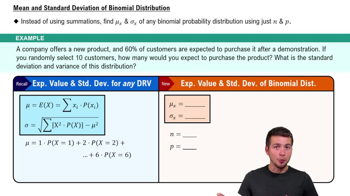
Mean & Standard Deviation of Binomial Distribution

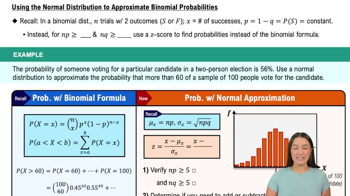
Normal Approximation to the Binomial

The normal approximation to the binomial distribution is applicable when the number of trials is large, and both np and n(1-p) are greater than 5. This allows us to use the normal distribution to estimate probabilities for binomial outcomes, simplifying calculations and providing a continuous approximation to the discrete binomial probabilities.
Recommended video:
06:23
Using the Normal Distribution to Approximate Binomial Probabilities

Unusual Events

An unusual event in statistics is typically defined as an outcome that has a low probability of occurring, often less than 5%. In the context of the binomial distribution, identifying unusual events helps in understanding the significance of certain results, such as the number of individuals willing to share their health information, and can guide further research or decision-making.
Recommended video:
05:54
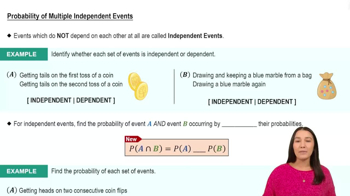
Probability of Multiple Independent Events
Related Practice
Textbook Question

Red Blood Cell Count Use the normal distribution in Exercise 16.


a. What percent of the adult males have a red blood cell count less than 6 million cells per microliter?
Textbook Question

[APPLET] Milk Consumption You are performing a study about weekly per capita milk consumption. A previous study found weekly per capita milk consumption to be normally distributed, with a mean of 48.7 fluid ounces and a standard deviation of 8.6 fluid ounces. You randomly sample 30 people and record the weekly milk consumptions shown below.

a. Draw a frequency histogram to display these data. Use seven classes. Do the consumptions appear to be normally distributed? Explain.

Textbook Question

Ice Cream The weights of ice cream cartons are normally distributed with a mean weight of 10 ounces and a standard deviation of 0.5 ounce.


a. What is the probability that a randomly selected carton has a weight greater than 10.21 ounces?


Textbook Question

Finding Specified Data Values In Exercises 31–38, answer the questions about the specified normal distribution.


Red Blood Cell Count The red blood cell counts (in millions of cells per microliter) for a population of adult males can be approximated by a normal distribution, with a mean of 5.4 million cells per microliter and a standard deviation of 0.4 million cells per microliter.


a. What is the minimum red blood cell count that can be in the top 25% of counts?


Textbook Question

Uniform Distribution A uniform distribution is a continuous probability distribution for a random variable x between two values a and b (a<b), where (a ≤ x ≤ b) and all of the values of x are equally likely to occur. The graph of a uniform distribution is shown below.

The probability density function of a uniform distribution is


on the interval from (x=a) to (x=b). For any value of x less than a or greater than b, y=0 . In Exercises 59 and 60, use this information.


For two values c and d, where a ≤ c < d ≤ b, the probability that x lies between c and d is equal to the area under the curve between c and d, as shown below.


So, the area of the red region equals the probability that x lies between c and d. For a uniform distribution from (a=1) to (b=25) , find the probability that


a. x lies between 2 and 8.

Textbook Question

Approximating Binomial Probabilities In Exercises 19–26, determine whether you can use a normal distribution to approximate the binomial distribution. If you can, use the normal distribution to approximate the indicated probabilities and sketch their graphs. If you cannot, explain why and use a binomial distribution to find the indicated probabilities. Identify any unusual events. Explain.


Athletes on Social Issues In a survey of college athletes, 84% said they are willing to speak up and be more active in social issues. You randomly select 25 college athletes. Find the probability that the number who are willing to speak up and be more active in social issues is (a) at least 24