
Ch. 4 - Discrete Probability Distributions
Larson - Elementary Statistics: Picturing the World 8th Edition
Larson8th EditionElementary Statistics: Picturing the WorldISBN: 9780137493470Not the one you use?Change textbook
Chapter 4, Problem 4.2.41b

Manufacturing An assembly line produces 10,000 automobile parts. Twenty percent of the parts are defective. An inspector randomly selects 10 of the parts


b. Because the sample is only 0.1% of the population, treat the events as independent and use the binomial probability formula to approximate the probability that none of the selected parts are defective.

Verified step by step guidance
1
Step 1: Identify the parameters of the binomial distribution. The binomial distribution is defined by two parameters: the number of trials (n) and the probability of success (p). Here, n = 10 (the number of parts selected) and p = 0.2 (the probability that a part is defective). The probability of a part not being defective is 1 - p = 0.8.
Step 2: Write the binomial probability formula. The formula for the probability of exactly k successes in n trials is: P(X = k) = (n choose k) * p^k * (1 - p)^(n - k), where (n choose k) = n! / [k! * (n - k)!].
Step 3: Substitute the values into the formula. Since we are calculating the probability that none of the selected parts are defective (k = 0), the formula becomes: P(X = 0) = (10 choose 0) * (0.2)^0 * (0.8)^10.
Step 4: Simplify the formula. (10 choose 0) = 1 because there is only one way to choose 0 items from 10. Also, (0.2)^0 = 1. Therefore, the formula simplifies to: P(X = 0) = 1 * 1 * (0.8)^10.
Step 5: Calculate (0.8)^10. This involves raising 0.8 to the power of 10. The result will give you the probability that none of the selected parts are defective.

Verified video answer for a similar problem:

This video solution was recommended by our tutors as helpful for the problem above.
Video duration:
2m
Was this helpful?

Key Concepts

Here are the essential concepts you must grasp in order to answer the question correctly.

Binomial Probability Distribution

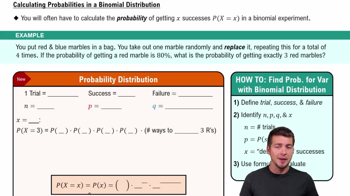
The binomial probability distribution models the number of successes in a fixed number of independent Bernoulli trials, each with the same probability of success. In this context, a 'success' refers to selecting a defective part. The formula for calculating the probability of exactly k successes in n trials is given by P(X = k) = (n choose k) * p^k * (1-p)^(n-k), where p is the probability of success.
Recommended video:
Guided course
06:39
Calculating Probabilities in a Binomial Distribution

Independence of Events

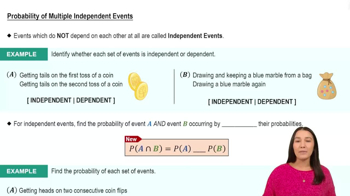
In probability theory, two events are considered independent if the occurrence of one does not affect the probability of the other occurring. In this scenario, treating the selection of parts as independent is justified because the sample size (10 parts) is small relative to the total population (10,000 parts), allowing us to ignore the slight changes in probabilities that would occur if the selections were dependent.
Recommended video:
05:54
Probability of Multiple Independent Events

Probability of No Defective Parts

To find the probability that none of the selected parts are defective, we can use the binomial formula with k = 0. This means we are interested in the probability of selecting 0 defective parts out of 10, given that the probability of selecting a defective part is 20% (or 0.2). The calculation simplifies to P(X = 0) = (1 - p)^n, which in this case is (0.8)^10, representing the probability that all selected parts are non-defective.
Recommended video:
5:37
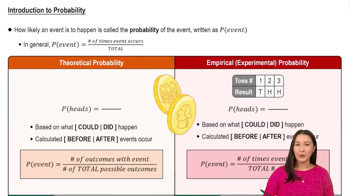
Introduction to Probability
Related Practice
Textbook Question

Using a Distribution to Find Probabilities In Exercises 11–26, find the indicated probabilities using the geometric distribution, the Poisson distribution, or the binomial distribution. Then determine whether the events are unusual. If convenient, use a table or technology to find the probabilities.


Living Donor Transplants The mean number of organ transplants from living donors performed per day in the United States in 2020 was about 16. Find the probability that the number of organ transplants from living donors performed on any given day is (c) no more than 10. (Source: Organ Procurement and Transplantation Network)

1
views
Textbook Question

Unusual Events In Exercises 37 and 38, find the indicated probabilities. Then determine if the event is unusual. Explain your reasoning.


Rock-Paper-Scissors The probability of winning a game of rock-paper-scissors is 1/3. You play nine games of rock-paper-scissors. Find the probability that the number of games you win is (b) more than five

1
views
Textbook Question

Using a Distribution to Find Probabilities In Exercises 11–26, find the indicated probabilities using the geometric distribution, the Poisson distribution, or the binomial distribution. Then determine whether the events are unusual. If convenient, use a table or technology to find the probabilities.


Living Donor Transplants The mean number of organ transplants from living donors performed per day in the United States in 2020 was about 16. Find the probability that the number of organ transplants from living donors performed on any given day is (b) at least eight (Source: Organ Procurement and Transplantation Network)

1
views
Textbook Question

Finding Probabilities Use the probability distribution you made in Exercise 19 to find the probability of randomly selecting a household that has (c) from one to three HD televisions,

1
views
Textbook Question

Hypergeometric Distribution Binomial experiments require that any sampling be done with replacement because each trial must be independent of the others. The hypergeometric distribution also has two outcomes: success and failure. The sampling, however, is done without replacement. For a population of N items having k successes and failures, the probability of selecting a sample of size that has successes and failures is given by

" style="max-width: 100%; white-space-collapse: preserve;" width="245">


In a shipment of 15 microchips, 2 are defective and 13 are not defective. A sample of three microchips is chosen at random. Use the above formula to find the probability that (b) one microchip is defective and two are not defective

2
views
Textbook Question

Using a Distribution to Find Probabilities In Exercises 11–26, find the indicated probabilities using the geometric distribution, the Poisson distribution, or the binomial distribution. Then determine whether the events are unusual. If convenient, use a table or technology to find the probabilities.


Oil Tankers In the month of June 2021, 240 oil tankers stop at a port city. No oil tanker visits more than once. Find the probability that the number of oil tankers that stop on any given day in June is (b) at most three

1
views