Ch. 4 - Discrete Probability Distributions
Larson - Elementary Statistics: Picturing the World 8th Edition
Larson8th EditionElementary Statistics: Picturing the WorldISBN: 9780137493470Not the one you use?Change textbook
Chapter 4, Problem 4.1.38

Finding an Expected Value In Exercises 37 and 38, find the expected value E(x) to the player for one play of the game. If x is the gain to a player in a game of chance, then E(x) is usually negative. This value gives the average amount per game the player can expect to lose.


A high school basketball team is selling \(10 raffle tickets as part of a fund-raising program. The first prize is a trip to the Bahamas valued at \)5460, and the second prize is a weekend ski package valued at \$496. The remaining 18 prizes are \$100 gas cards. The number of tickets sold is 3500.

Verified step by step guidance
1
Step 1: Understand the concept of expected value. The expected value E(x) is calculated as the sum of the products of each outcome's value and its probability. The formula is: E(x) = Σ [x_i * P(x_i)], where x_i is the value of the outcome and P(x_i) is the probability of that outcome.
Step 2: Identify the outcomes and their respective values. In this problem, the outcomes are: (1) winning the trip to the Bahamas valued at \$5460, (2) winning the ski package valued at \$496, (3) winning one of the 18 gas cards valued at \(100 each, and (4) not winning anything, which has a value of -\)10 (the cost of the ticket).
Step 3: Calculate the probabilities of each outcome. The probability of winning the trip to the Bahamas is 1/3500, the probability of winning the ski package is 1/3500, the probability of winning a gas card is 18/3500, and the probability of not winning anything is (3500 - 20)/3500 = 3480/3500.
Step 4: Multiply each outcome's value by its probability. For example, the contribution to E(x) from the trip to the Bahamas is (5460 * 1/3500), from the ski package is (496 * 1/3500), from the gas cards is (100 * 18/3500), and from not winning is (-10 * 3480/3500).
Step 5: Add up all the contributions from Step 4 to find the expected value E(x). This will give you the average amount the player can expect to gain or lose per game.

Verified video answer for a similar problem:

This video solution was recommended by our tutors as helpful for the problem above.
Video duration:
5m
Was this helpful?

Key Concepts

Here are the essential concepts you must grasp in order to answer the question correctly.

Expected Value

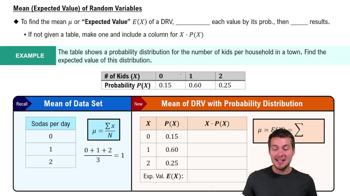
Expected value (E(x)) is a fundamental concept in probability and statistics that represents the average outcome of a random variable over many trials. It is calculated by multiplying each possible outcome by its probability and summing these products. In the context of games of chance, the expected value often indicates the average loss or gain a player can anticipate per game, helping to assess the fairness of the game.
Recommended video:
Guided course
04:14
Expected Value (Mean) of Random Variables

Probability

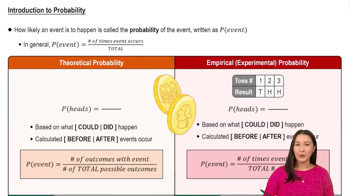
Probability is a measure of the likelihood that a particular event will occur, expressed as a number between 0 and 1. In the context of the raffle, the probability of winning each prize is determined by the ratio of the number of winning tickets to the total number of tickets sold. Understanding probability is essential for calculating expected values, as it directly influences the outcomes and their associated values.
Recommended video:
5:37
Introduction to Probability

Game of Chance

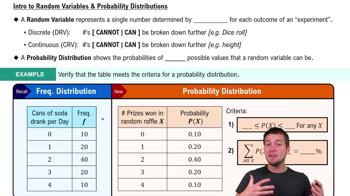
A game of chance is a game whose outcome is strongly influenced by randomizing devices, such as dice, cards, or lottery tickets, rather than skill. In such games, players often face uncertainty regarding their potential gains or losses. Analyzing the expected value in games of chance helps players understand the risks involved and make informed decisions about participation.
Recommended video:
Guided course
07:09
Intro to Random Variables & Probability Distributions
Related Practice
Textbook Question

Determining a Missing Probability In Exercises 25 and 26, determine the missing probability for the probability distribution.
Textbook Question

"Using a Distribution to Find Probabilities In Exercises 11–26, find the indicated probabilities using the geometric distribution, the Poisson distribution, or the binomial distribution. Then determine whether the events are unusual. If convenient, use a table or technology to find the probabilities.


Typographical Errors A newspaper finds that the mean number of typographical errors per page is four. Find the probability that the number of typographical errors found on any given page is (a) exactly three, (b) at most three, and (c) more than three."

Textbook Question

Geometric Distribution: Mean and Variance In Exercises 29 and 30, use the fact that the mean of a geometric distribution is μ = 1/p and the variance is

sigma^2 = q/p^2

Paycheck Errors A company assumes that 0.5% of the paychecks for a year were calculated incorrectly. The company has 200 employees and examines the payroll records from one month. (a) Find the mean, variance, and standard deviation. (b) How many employee payroll records would you expect to examine before finding one with an error?

Textbook Question

Baseball There were 116 World Series from 1903 to 2020. Use the probability distribution in Exercise 30 to find the number of World Series that had 4, 5, 6, 7, and 8 games. Find the population mean, variance, and standard deviation of the data using the traditional definitions. Compare to your answers in Exercise 30.

Textbook Question

In Exercises 1–4, find the indicated probability using the geometric distribution.


Find P(5) when p = 0.09

Textbook Question

True or False? In Exercises 5–8, determine whether the statement is true or false. If it is false, rewrite it as a true statement.


For a random variable x, the word random indicates that the value of x is determined by chance.