Ch. 4 - Discrete Probability Distributions
Larson - Elementary Statistics: Picturing the World 8th Edition
Larson8th EditionElementary Statistics: Picturing the WorldISBN: 9780137493470Not the one you use?Change textbook
Chapter 4, Problem 4.1.19

Constructing and Graphing Discrete Probability Distributions In Exercises 19 and 20, (a) construct a probability distribution, and (b) graph the probability distribution using a histogram and describe its shape.


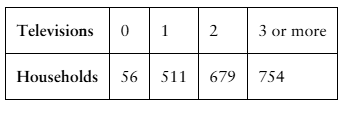
Televisions The number of high-definition (HD) televisions per household in a small town
Table showing the number of households with 0, 1, 2, and 3 or more televisions in a small town.

Verified step by step guidance
1
Step 1: Calculate the total number of households by summing the values in the 'Households' row. This will be used to determine the probabilities for the probability distribution.
Step 2: For each category of televisions (0, 1, 2, 3 or more), calculate the probability by dividing the number of households in that category by the total number of households. Use the formula: P(X = x) = (Number of households for x televisions) / (Total number of households).
Step 3: Construct the probability distribution table. The table should include two columns: one for the number of televisions (0, 1, 2, 3 or more) and one for the corresponding probabilities calculated in Step 2.
Step 4: Create a histogram to graph the probability distribution. On the x-axis, plot the number of televisions (0, 1, 2, 3 or more), and on the y-axis, plot the probabilities. Ensure the bars are proportional to the probabilities.
Step 5: Analyze the shape of the histogram. Determine whether the distribution is symmetric, skewed left, skewed right, or uniform based on the heights of the bars.

Verified video answer for a similar problem:

This video solution was recommended by our tutors as helpful for the problem above.
Video duration:
4m
Was this helpful?

Key Concepts

Here are the essential concepts you must grasp in order to answer the question correctly.

Discrete Probability Distribution

A discrete probability distribution describes the likelihood of each possible outcome in a discrete sample space. In this context, it represents the number of high-definition televisions per household, where each outcome (0, 1, 2, or 3 or more televisions) has a corresponding probability calculated by dividing the number of households with that outcome by the total number of households.
Recommended video:
Guided course
04:48
Variance & Standard Deviation of Discrete Random Variables

Histogram

A histogram is a graphical representation of the distribution of numerical data, where the data is divided into bins or intervals. In this case, the histogram will display the frequency of households for each category of televisions, allowing for a visual interpretation of the probability distribution and helping to identify patterns or trends in the data.
Recommended video:
Guided course
05:54
Intro to Histograms

Shape of the Distribution

The shape of a probability distribution provides insights into the data's characteristics, such as symmetry, skewness, and modality. For the given data on televisions per household, analyzing the histogram's shape will help determine whether the distribution is uniform, normal, skewed, or has multiple peaks, which can inform conclusions about household television ownership in the small town.
Recommended video:
05:11
Sampling Distribution of Sample Proportion