
Ch. 3 - Probability
Larson - Elementary Statistics: Picturing the World 8th Edition
Larson8th EditionElementary Statistics: Picturing the WorldISBN: 9780137493470Not the one you use?Change textbook
Chapter 3, Problem 3.2.27b

"Using the Multiplication Rule In Exercises 19-32, use the Multiplication Rule.
27. Blood Types The probability that a person of Asian descent in the United States has type O+ blood is 39%. At random, six people of Asian descent in the United States are selected. (Source: American National Red Cross)
b. Find the probability that none of the six have type O+ blood."

Verified step by step guidance
1
Step 1: Understand the problem. We are tasked with finding the probability that none of the six randomly selected people of Asian descent have type O+ blood. The probability of a person having type O+ blood is given as 39%, or 0.39.
Step 2: Define the complement probability. The complement of a person having type O+ blood is the probability that they do not have type O+ blood. This is calculated as 1 - 0.39 = 0.61.
Step 3: Use the Multiplication Rule. Since the six people are selected independently, the probability that none of them have type O+ blood is the product of the complement probability for each individual. This can be expressed as \( P(\text{none have O+}) = (0.61)^6 \).
Step 4: Write the general formula. The general formula for this type of problem is \( P(\text{none have O+}) = (1 - p)^n \), where \( p \) is the probability of having type O+ blood (0.39 in this case), and \( n \) is the number of people selected (6 in this case).
Step 5: Substitute the values into the formula. Substitute \( p = 0.39 \) and \( n = 6 \) into the formula to calculate \( P(\text{none have O+}) = (1 - 0.39)^6 = (0.61)^6 \).

Verified video answer for a similar problem:

This video solution was recommended by our tutors as helpful for the problem above.
Video duration:
2m
Was this helpful?

Key Concepts

Here are the essential concepts you must grasp in order to answer the question correctly.

Multiplication Rule

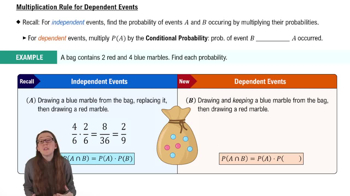
The Multiplication Rule in probability states that the probability of two independent events occurring together is the product of their individual probabilities. In this context, it is used to calculate the likelihood of multiple events happening simultaneously, such as selecting individuals with a specific blood type. For independent events, this rule simplifies the calculation of combined probabilities.
Recommended video:
05:17
Multiplication Rule: Dependent Events

Independent Events

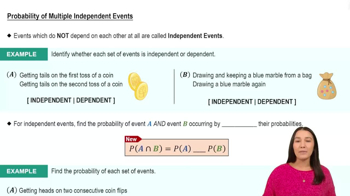
Independent events are those whose outcomes do not affect each other. In the given problem, the selection of one person does not influence the blood type of another selected person. Understanding that the events are independent allows us to apply the Multiplication Rule effectively to find the overall probability of multiple individuals not having type O+ blood.
Recommended video:
05:54
Probability of Multiple Independent Events

Complementary Probability

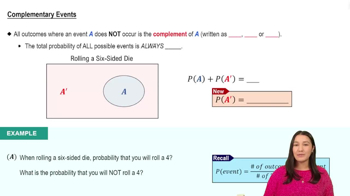
Complementary probability refers to the likelihood of an event not occurring, which is calculated as 1 minus the probability of the event occurring. In this scenario, to find the probability that none of the six selected individuals have type O+ blood, we first determine the probability that one person does not have type O+ blood and then apply the Multiplication Rule to find the combined probability for all six individuals.
Recommended video:
4:23
Complementary Events
Related Practice
Textbook Question

25. Working from Home The table shows the results of a survey that asked 1811 people how often they work from home. A person is selected at random from the sample. Find the probability of each event.

b. The person is female or does not work from home.

" style="" width="400">

1
views
Textbook Question

"Using the Multiplication Rule In Exercises 19-32, use the Multiplication Rule.

25. Best President In a sample of 1500 adult U.S. citizens, 270 said that Barack Obama was the best president in U.S. history. Two adult U.S. citizens are selected at random.

(Adapted from YouGov)

b. Find the probability that neither adult U.S. citizen says that Barack Obama was the best president in U.S. history."

Textbook Question

"Using the Multiplication Rule In Exercises 19-32, use the Multiplication Rule.

24. Knowing a Person Who Was Murdered In a sample of 11,771 children ages 2 to 17, 8% have lost a friend or relative to murder. Four children are selected at random. (Adapted from University of New Hampshire)

b. Find the probability that none of the four has lost a friend or relative to murder."

Textbook Question

"Using the Multiplication Rule In Exercises 19-32, use the Multiplication Rule.

25. Best President In a sample of 1500 adult U.S. citizens, 270 said that Barack Obama was the best president in U.S. history. Two adult U.S. citizens are selected at random.

(Adapted from YouGov)

c. Find the probability that at least one of the two adult U.S. citizens says that Barack Obama was the best president in U.S. history."

Textbook Question

19. U.S. Age Distribution The projected percent distribution of the U.S. population for 2025 is shown in the pie chart. Find the probability of each event. (Source: U.S. Census

Bureau)

c. Randomly selecting someone who is not 60 years or over

Textbook Question

88. Individual Stock Price An individual stock is selected at random from the portfolio represented by the box-and-whisker plot shown. Find the probability that the stock price is between \$21 and \$50.