Ch. 3 - Probability
Larson - Elementary Statistics: Picturing the World 8th Edition
Larson8th EditionElementary Statistics: Picturing the WorldISBN: 9780137493470Not the one you use?Change textbook
Chapter 3, Problem 3.2.22

"Using the Multiplication Rule In Exercises 19-32, use the Multiplication Rule.
22.Pickup Trucks In a survey, 510 U.S. adults were asked whether they drive a pickup truck and whether they drive a Ford. The results showed that three in twenty adults surveyed drive a Ford. Of the adults surveyed that drive Fords, nine in twenty drive a pickup truck. Find the probability that a randomly selected adult drives a Ford and drives a pickup truck.

Verified step by step guidance
1
Step 1: Understand the Multiplication Rule for probability. The rule states that the probability of two events A and B occurring together (denoted as P(A and B)) is equal to the probability of event A occurring multiplied by the probability of event B occurring given that A has occurred. Mathematically, this is expressed as: P(A and B) = P(A) × P(B|A).
Step 2: Identify the events in the problem. Event A is 'an adult drives a Ford,' and event B is 'an adult drives a pickup truck.' The problem provides the probabilities: P(A) = 3/20 (three in twenty adults drive a Ford), and P(B|A) = 9/20 (nine in twenty adults who drive Fords also drive a pickup truck).
Step 3: Apply the Multiplication Rule. Substitute the given probabilities into the formula: P(A and B) = P(A) × P(B|A). This will calculate the probability that a randomly selected adult drives a Ford and drives a pickup truck.
Step 4: Simplify the multiplication. Multiply the fractions P(A) = 3/20 and P(B|A) = 9/20 to find the combined probability. Remember to multiply the numerators and denominators separately.
Step 5: Interpret the result. The final probability represents the likelihood that a randomly selected adult drives both a Ford and a pickup truck. Ensure the result is expressed as a fraction or decimal, depending on the context of the problem.

Verified video answer for a similar problem:

This video solution was recommended by our tutors as helpful for the problem above.
Video duration:
1m
Was this helpful?

Key Concepts

Here are the essential concepts you must grasp in order to answer the question correctly.

Multiplication Rule

The Multiplication Rule in probability states that the probability of two independent events occurring together is the product of their individual probabilities. In this context, it helps calculate the likelihood of an adult driving both a Ford and a pickup truck by multiplying the probability of driving a Ford by the conditional probability of driving a pickup truck given that they drive a Ford.
Recommended video:
05:17
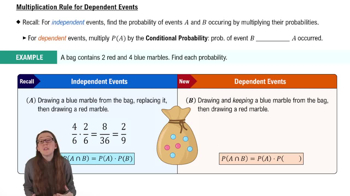
Multiplication Rule: Dependent Events

Conditional Probability

Conditional probability refers to the probability of an event occurring given that another event has already occurred. In this scenario, it is crucial to determine the probability of an adult driving a pickup truck, given that they already drive a Ford. This concept allows for a more accurate calculation of joint probabilities in dependent events.
Recommended video:
03:53
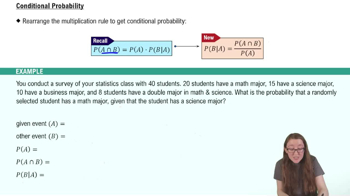
Conditional Probability Rule

Venn Diagrams

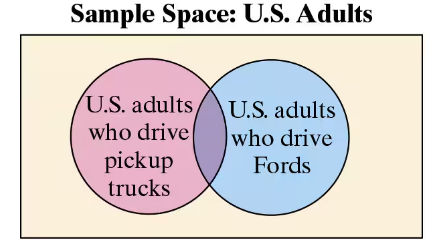
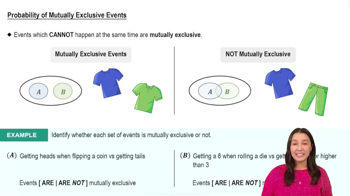
Venn diagrams are visual representations used to illustrate the relationships between different sets. In this case, the diagram shows the overlap between U.S. adults who drive pickup trucks and those who drive Fords. This visual aid helps in understanding the sample space and the intersection of the two groups, which is essential for calculating the combined probabilities.
Recommended video:
5:14
Probability of Mutually Exclusive Events
Related Practice
Textbook Question

13. Students A physics class has 40 students. Of these, 12 students are physics majors and 16 students are minoring in math. Of the physics majors, three are minoring in math. Find the probability that a randomly selected student is minoring in math or a physics major.

1
views
Textbook Question

"Classifying Events Based on Studies In Exercises 15-18, identify the two events described in the study. Do the results indicate that the events are independent or dependent? Explain your reasoning.

15. A study was conducted to debunk the idea that abilities in music and math are related. Instead, the study showed a strong relationship between achievements in music and math.

(Source: University of Kansas)"

Textbook Question

Classifying Events as Independent or Dependent In Exercises 9-14, determine whether the events are independent or dependent. Explain your reasoning.

11. Returning a rented movie after the due date and receiving a late fee

Textbook Question

"Identifying the Sample Space of a Probability Experiment In Exercises 25-32, identify the sample space of the probability experiment and determine the number of outcomes in the sample space. Draw a tree diagram when appropriate.

26. Guessing a student's letter grade (A, B, C, D, F) in a class

"

1
views
Textbook Question

True or False? In Exercises 7-10, determine whether the statement is true or false. If it is false, rewrite it as a true statement.

9. A probability of 1/10 indicates an unusual event.

Textbook Question

"According to Bayes’ Theorem, the probability of event A , given that event B has occurred, is

P(A|B) = P(A) * P(B|A)P(A) * P(B|A) + P(A') * P(B|A').

In Exercises 33–38, use Bayes’ Theorem to find P(A|B).

38. P(A) = 12%, P(A') = 88%, P(B|A) = 66% , and P(B|A') = 19% "

1
views