Ch. 3 - Probability
Larson - Elementary Statistics: Picturing the World 8th Edition
Larson8th EditionElementary Statistics: Picturing the WorldISBN: 9780137493470Not the one you use?Change textbook
Chapter 3, Problem 3.1.49

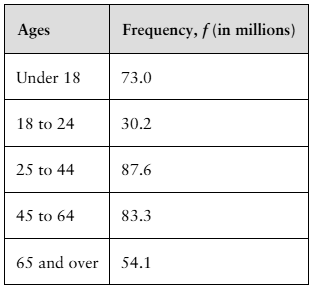
Using a Frequency Distribution to Find Probabilities In Exercises 49-52, use the frequency distribution at the left, which shows the population of the United States by age group, to find the probability that a U.S. resident chosen at random is in the age range. (Source: U.S. Census Bureau)
49. 18 to 24 years old
tab1

Verified step by step guidance
1
Step 1: Understand the problem. We are tasked with finding the probability that a randomly chosen U.S. resident falls within the age range of 18 to 24 years old. To do this, we will use the frequency distribution table provided.
Step 2: Identify the relevant data. From the table, the frequency for the age group 18 to 24 years old is 30.2 million. The total population is the sum of all frequencies in the table: 73.0 + 30.2 + 87.6 + 83.3 + 54.1 (all values in millions).
Step 3: Calculate the total population. Add up all the frequencies to find the total population in millions. This will be the denominator in the probability calculation.
Step 4: Set up the probability formula. The probability of a randomly chosen resident being in the age range 18 to 24 years old is given by the formula: \( P = \frac{\text{Frequency of 18 to 24 years old}}{\text{Total Population}} \). Substitute the values from the table into this formula.
Step 5: Simplify the fraction. Divide the frequency for the age group 18 to 24 years old (30.2 million) by the total population (calculated in Step 3). This will give the probability as a decimal or percentage.

Verified video answer for a similar problem:

This video solution was recommended by our tutors as helpful for the problem above.
Video duration:
2m
Was this helpful?

Key Concepts

Here are the essential concepts you must grasp in order to answer the question correctly.

Frequency Distribution

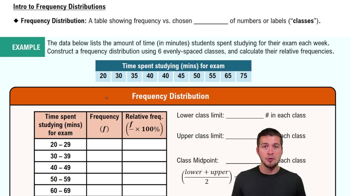
A frequency distribution is a summary of how often each value occurs in a dataset. It organizes data into categories, showing the number of occurrences (frequency) for each category. In this case, the frequency distribution presents the population of the United States segmented by age groups, allowing for easy analysis of demographic data.
Recommended video:
Guided course
06:38
Intro to Frequency Distributions

Probability

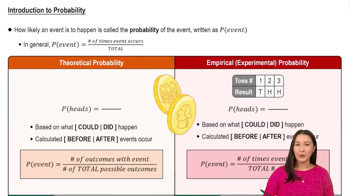
Probability is a measure of the likelihood that a particular event will occur, expressed as a number between 0 and 1. In the context of the question, it involves calculating the chance that a randomly selected U.S. resident falls within a specific age range, using the frequencies from the distribution to determine the proportion of the population in that range.
Recommended video:
5:37
Introduction to Probability

Relative Frequency

Relative frequency is the ratio of the frequency of a specific category to the total number of observations. It provides a way to express the frequency of an age group as a proportion of the total population, which is essential for calculating probabilities. For example, to find the probability of selecting someone aged 18 to 24, one would divide the frequency of that age group by the total population.
Recommended video:
Guided course
06:38
Intro to Frequency Distributions