Ch. 3 - Probability
Larson - Elementary Statistics: Picturing the World 8th Edition
Larson8th EditionElementary Statistics: Picturing the WorldISBN: 9780137493470Not the one you use?Change textbook
Chapter 3, Problem 3.4.44b

Officers The offices of president, vice president, secretary, and treasurer for an environmental club will be filled from a pool of 14 candidates. Six of the candidates are members of the debate team.
b. What is the probability that none of the offices are filled by members of the debate team?

Verified step by step guidance
1
Step 1: Understand the problem. We are tasked with finding the probability that none of the four offices (president, vice president, secretary, and treasurer) are filled by members of the debate team. There are 14 candidates in total, 6 of whom are members of the debate team, leaving 8 candidates who are not members of the debate team.
Step 2: Calculate the total number of ways to assign the four offices. Since the order of selection matters (e.g., president is different from vice president), this is a permutation problem. The total number of permutations is given by the formula: P(14,4)=14!(14-4)!.
Step 3: Calculate the number of favorable outcomes where none of the offices are filled by members of the debate team. Since there are 8 candidates who are not members of the debate team, we calculate the number of permutations of 4 offices from these 8 candidates using the formula: P(8,4)=8!(8-4)!.
Step 4: Compute the probability that none of the offices are filled by members of the debate team. The probability is the ratio of the number of favorable outcomes to the total number of outcomes: P=P(8,4)P(14,4).
Step 5: Simplify the probability expression and interpret the result. This will give you the likelihood that none of the offices are filled by members of the debate team. Ensure you understand that this probability is based on the assumption that all candidates are equally likely to be chosen.

Verified video answer for a similar problem:

This video solution was recommended by our tutors as helpful for the problem above.
Video duration:
4m
Was this helpful?

Key Concepts

Here are the essential concepts you must grasp in order to answer the question correctly.

Probability

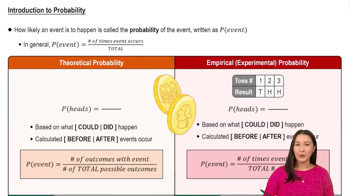
Probability is a measure of the likelihood that a particular event will occur, expressed as a number between 0 and 1. In this context, it involves calculating the chance that none of the selected candidates for the club offices are members of the debate team. Understanding how to compute probabilities is essential for solving the question.
Recommended video:
5:37
Introduction to Probability

Combinatorics

Combinatorics is a branch of mathematics dealing with combinations and permutations of objects. In this scenario, it is crucial to determine how many ways the offices can be filled from the pool of candidates, specifically focusing on the selection of candidates who are not members of the debate team. This concept helps in calculating the total possible outcomes.

Complementary Events

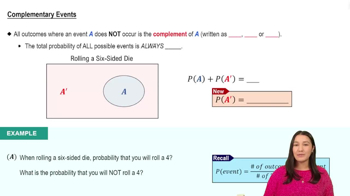
Complementary events are pairs of outcomes where one event occurs if and only if the other does not. In this question, the event of interest is that none of the offices are filled by debate team members, which can be analyzed by considering the complementary event of at least one office being filled by a debate team member. This understanding aids in simplifying the probability calculations.
Recommended video:
4:23
Complementary Events
Related Practice
Textbook Question

25. Working from Home The table shows the results of a survey that asked 1811 people how often they work from home. A person is selected at random from the sample. Find the probability of each event.

b. The person is female or does not work from home.

" style="" width="400">

1
views
Textbook Question

"Using the Multiplication Rule In Exercises 19-32, use the Multiplication Rule.

25. Best President In a sample of 1500 adult U.S. citizens, 270 said that Barack Obama was the best president in U.S. history. Two adult U.S. citizens are selected at random.

(Adapted from YouGov)

b. Find the probability that neither adult U.S. citizen says that Barack Obama was the best president in U.S. history."

Textbook Question

"Using the Multiplication Rule In Exercises 19-32, use the Multiplication Rule.

23. Celebrities as Role Models In a sample of 1103 probable voters, three out of four say they would like entertainers to address social and political issues. Two probable voters are selected at random. (Source: The Hollywood Reporter)

b. Find the probability that neither probable voter would like entertainers to address social and political issues."

Textbook Question

Politics The responses of 1500 U.S. adults to a survey that asked them to state their own political viewpoints are shown in the Pareto chart. Find the probability of each event.(Adapted from YouGov)

b. Randomly selecting a person from the sample who is conservative or very conservative

Textbook Question

Finding Conditional Probabilities In Exercises 7 and 8, use the table to find each conditional probability.

8. Retirement Savings The table shows the results of a survey in which 250 male and 250 female workers ages 25 to 64 were asked if they contribute to a retirement savings plan at

work.

b. Find the probability that a randomly selected worker is female, given that the worker contributes to a retirement savings plan at work.

Textbook Question

22. Brexit A survey asked 1115 British adults how Britain's decision to leave the European Union has impacted the country. The results are shown in the Pareto chart. Find the

probability of each event. (Adapted from Ipsos)

b. Randomly selecting a British adult who feels that the move has had a very negative impact on Great Britain