Ch. 3 - Probability
Larson - Elementary Statistics: Picturing the World 8th Edition
Larson8th EditionElementary Statistics: Picturing the WorldISBN: 9780137493470Not the one you use?Change textbook
Chapter 3, Problem 3.3.24c

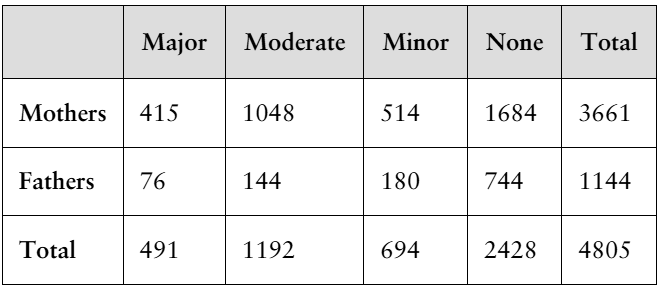
Mental Health A survey asks 4805 parents the severity of the mental issues they experienced from the coronavirus pandemic. The results are shown in the table. A parent is randomly selected from the sample. Find the probability of each event. (Adapted from Kaiser Family Foundation)
<IMAGE>
c. The parent did not have major mental health issues or is a mother.

Verified step by step guidance
1
Step 1: Understand the problem. We are tasked with finding the probability that a randomly selected parent either did not have major mental health issues or is a mother. This involves using the addition rule for probabilities and understanding the complement of 'major mental health issues.'
Step 2: Identify the relevant data. From the table, the total number of parents surveyed is 4805. The number of parents who did not have major mental health issues (i.e., those with moderate, minor, or none) is the sum of the values in the 'Moderate,' 'Minor,' and 'None' columns: 1192 + 694 + 2428 = 4314. The number of mothers surveyed is 3661.
Step 3: Use the addition rule for probabilities. The probability of event A (not having major mental health issues) or event B (being a mother) is calculated as P(A or B) = P(A) + P(B) - P(A and B).
Step 4: Calculate P(A), P(B), and P(A and B). P(A) is the probability of not having major mental health issues, which is 4314/4805. P(B) is the probability of being a mother, which is 3661/4805. P(A and B) is the probability of being a mother and not having major mental health issues, which is the sum of the 'Moderate,' 'Minor,' and 'None' values for mothers: (1048 + 514 + 1684)/4805.
Step 5: Substitute the values into the formula P(A or B) = P(A) + P(B) - P(A and B) to find the probability. Simplify the fractions and calculate the result.

Verified video answer for a similar problem:

This video solution was recommended by our tutors as helpful for the problem above.
Video duration:
5m
Was this helpful?

Key Concepts

Here are the essential concepts you must grasp in order to answer the question correctly.

Probability

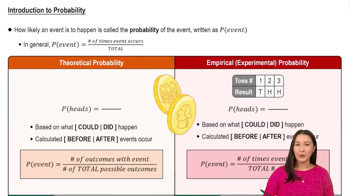
Probability is a measure of the likelihood that an event will occur, expressed as a number between 0 and 1. In this context, it involves calculating the chance of selecting a parent who either did not experience major mental health issues or is a mother. This can be determined by dividing the number of favorable outcomes by the total number of outcomes.
Recommended video:
5:37
Introduction to Probability

Complementary Events

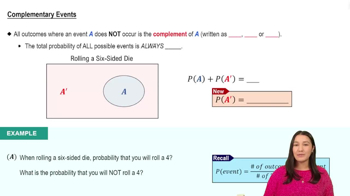
Complementary events are two outcomes of an event that are mutually exclusive and collectively exhaustive. In this case, the event of a parent not having major mental health issues or being a mother can be analyzed by considering the complementary event, which is a parent having major mental health issues and being a father. Understanding complementary events helps in calculating probabilities more efficiently.
Recommended video:
4:23
Complementary Events

Conditional Probability

Conditional probability refers to the probability of an event occurring given that another event has already occurred. In this scenario, it may be useful to consider the conditional probabilities of being a mother or not having major mental health issues, as these factors can influence the overall probability calculation. This concept is essential for understanding how different conditions affect the likelihood of outcomes.
Recommended video:
5:37
Introduction to Probability
Related Practice
Textbook Question

2. Determine whether each number could represent the probability of an event. Explain your reasoning. c. 2.3

Textbook Question

Using the Multiplication Rule In Exercises 19-32, use the Multiplication Rule.

26. Worst President In a sample of 1500 adult U.S. citizens, 690 said that Donald Trump was the worst president in U.S. history. Three adult U.S. citizens are selected at random.

(Adapted from YouGov)

c. Find the probability that at most two of the three adult U.S. citizens say that Donald Trump was the worst president in U.S. history.

Textbook Question

22. Brexit A survey asked 1115 British adults how Britain's decision to leave the European Union has impacted the country. The results are shown in the Pareto chart. Find the

probability of each event. (Adapted from Ipsos)

d. Randomly selecting a British adult who feels that the move has had a fairly positive or very positive impact on Great Britain

Textbook Question

Using the Multiplication Rule In Exercises 19-32, use the Multiplication Rule.

27. Blood Types The probability that a person of Asian descent in the United States has type O+ blood is 39%. At random, six people of Asian descent in the United States are selected. (Source: American National Red Cross)

c. Find the probability that at least one of the six has type O+ blood.

Textbook Question

81. Genetics A Punnett square is a diagram that shows all possible gene combinations in a cross of parents whose genes are known. When two pink snapdragon flowers (RW) are crossed, there are four equally likely possible outcomes for the genetic makeup of the offspring: red (RR), pink (RW), pink (WR), and white (WW), as shown in the Punnett square at the left. When two pink snapdragons are crossed, what is the probability that the offspring will be (c) white?

Textbook Question

Politics The responses of 1500 U.S. adults to a survey that asked them to state their own political viewpoints are shown in the Pareto chart. Find the probability of each event.(Adapted from YouGov)

d. Randomly selecting a person from the sample who is either unsure or moderate