Ch. 3 - Probability
Larson - Elementary Statistics: Picturing the World 8th Edition
Larson8th EditionElementary Statistics: Picturing the WorldISBN: 9780137493470Not the one you use?Change textbook
Chapter 3, Problem 3.1.16

Matching Probabilities In Exercises 11-16, match the event with its probability.
a. 0.95
b. 0.005
c. 0.25
d. 0
e. 0.375
f. 0.5
16. You toss a coin four times. What is the probability of tossing tails exactly half of the time?

Verified step by step guidance
1
Step 1: Recognize that the problem involves a binomial probability distribution because there are a fixed number of trials (4 coin tosses), two possible outcomes (heads or tails), and the probability of success (tossing tails) is constant at 0.5 for each trial.
Step 2: Use the binomial probability formula to calculate the probability of getting exactly 2 tails in 4 tosses. The formula is: P(X = k) = (n choose k) * p^k * (1-p)^(n-k), where n is the number of trials, k is the number of successes, and p is the probability of success.
Step 3: Substitute the values into the formula: n = 4 (number of tosses), k = 2 (exactly half of the tosses are tails), and p = 0.5 (probability of tails). The formula becomes: P(X = 2) = (4 choose 2) * (0.5)^2 * (1-0.5)^2.
Step 4: Calculate the binomial coefficient (4 choose 2), which is given by the formula: (n choose k) = n! / [k! * (n-k)!]. For this case, (4 choose 2) = 4! / [2! * (4-2)!] = 6.
Step 5: Multiply the binomial coefficient by the probabilities: P(X = 2) = 6 * (0.5)^2 * (0.5)^2. Simplify the expression to find the final probability.

Verified video answer for a similar problem:

This video solution was recommended by our tutors as helpful for the problem above.
Video duration:
2m
Was this helpful?

Key Concepts

Here are the essential concepts you must grasp in order to answer the question correctly.

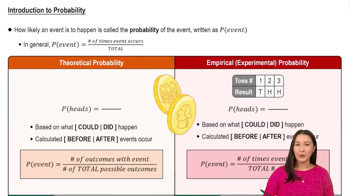
Probability

Probability is a measure of the likelihood that an event will occur, expressed as a number between 0 and 1. A probability of 0 indicates an impossible event, while a probability of 1 indicates a certain event. In this context, understanding how to calculate the probability of specific outcomes, such as tossing tails in a series of coin flips, is essential.
Recommended video:
5:37
Introduction to Probability

Binomial Distribution

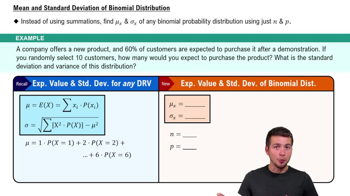
The binomial distribution is a probability distribution that describes the number of successes in a fixed number of independent Bernoulli trials, each with the same probability of success. In the case of tossing a coin, it helps determine the probability of getting a certain number of tails (successes) in a set number of tosses. This concept is crucial for solving the problem of tossing tails exactly half the time in four tosses.
Recommended video:
Guided course
03:28
Mean & Standard Deviation of Binomial Distribution

Combinatorics

Combinatorics is a branch of mathematics dealing with combinations and permutations of objects. In probability problems involving multiple trials, such as coin tosses, combinatorial methods are used to calculate the number of ways a specific outcome can occur. For example, determining how many ways you can get two tails in four tosses is essential for finding the corresponding probability.