Ch. 3 - Probability
Larson - Elementary Statistics: Picturing the World 8th Edition
Larson8th EditionElementary Statistics: Picturing the WorldISBN: 9780137493470Not the one you use?Change textbook
Chapter 3, Problem 3.1.61

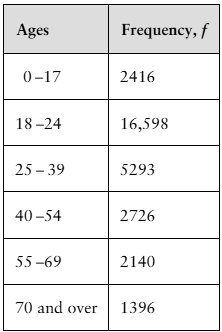
Finding the Probability of the Complement of an Event The age distribution of the residents of Ithaca, New York, is shown at the left. In Exercises 59-62, find the probability of the event. (Source: U.S. Census Bureau)
61. Event C: A randomly chosen resident of Ithaca is not less than 18 years old.
tab2

Verified step by step guidance
1
Step 1: Understand the problem. The goal is to find the probability of the complement of Event C, which is the probability that a randomly chosen resident of Ithaca is less than 18 years old. The complement of an event is calculated as 1 minus the probability of the event itself.
Step 2: Calculate the total population of Ithaca by summing up all the frequencies provided in the table. Add the frequencies for all age groups: 2416 (ages 0–17), 16,598 (ages 18–24), 5293 (ages 25–39), 2726 (ages 40–54), 2140 (ages 55–69), and 1396 (ages 70 and over). Use the formula: Total Population = Σf.
Step 3: Determine the frequency of residents who are less than 18 years old. From the table, this corresponds to the frequency for the age group 0–17, which is 2416.
Step 4: Calculate the probability of a resident being less than 18 years old. Use the formula: P(A) = Frequency of Age Group / Total Population. Here, P(A) = 2416 / Total Population.
Step 5: Find the probability of the complement of Event C. Use the formula: P(C') = 1 - P(C), where P(C') is the probability of being less than 18 years old. Substitute the value of P(A) calculated in Step 4 into this formula.

Verified video answer for a similar problem:

This video solution was recommended by our tutors as helpful for the problem above.
Video duration:
3m
Was this helpful?

Key Concepts

Here are the essential concepts you must grasp in order to answer the question correctly.

Complement of an Event

The complement of an event refers to all outcomes in a sample space that are not included in the event itself. For example, if Event C is defined as a randomly chosen resident being 18 years or older, the complement would be all residents younger than 18. Understanding complements is crucial for calculating probabilities, as the probability of an event plus the probability of its complement equals one.
Recommended video:
4:23
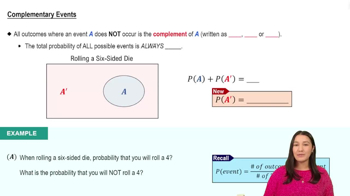
Complementary Events

Probability Calculation

Probability is a measure of the likelihood that a particular event will occur, expressed as a number between 0 and 1. To find the probability of an event, you divide the number of favorable outcomes by the total number of possible outcomes. In this case, to find the probability of residents not being less than 18 years old, you would sum the frequencies of the age groups 18-24, 25-39, 40-54, 55-69, and 70 and over, and divide by the total population.
Recommended video:
Guided course
07:09
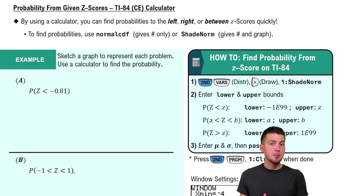
Probability From Given Z-Scores - TI-84 (CE) Calculator

Frequency Distribution

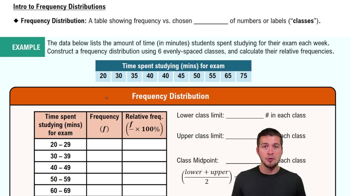
A frequency distribution is a summary of how often each value occurs in a dataset. In this context, the table shows the number of residents in different age groups, which helps in understanding the population structure. Analyzing the frequency distribution allows for easier calculations of probabilities and insights into demographic trends, such as the proportion of residents who are 18 years or older.
Recommended video:
Guided course
06:38
Intro to Frequency Distributions
Related Practice
Textbook Question

Matching Probabilities In Exercises 11-16, match the event with its probability.

a. 0.95

b. 0.005

c. 0.25

d. 0

e. 0.375

f. 0.5

14. A game show contestant must randomly select a door. One door doubles her money while the other three doors leave her with no winnings. What is the probability she selects the

door that doubles her money?

Textbook Question

Recognizing Mutually Exclusive Events In Exercises 9–12, determine whether the events are mutually exclusive. Explain your reasoning.

10. Event A: Randomly select a student with a birthday in April.

Event B: Randomly select a student with a birthday in May.

1
views
Textbook Question

Classifying Types of Probability In Exercises 53-58, classify the statement as an example of classical probability, empirical probability, or subjective probability. Explain your reasoning.

55. An analyst feels that the probability of a team winning an upcoming game is 60%.

Textbook Question

Finding the Probability of the Complement of an Event In Exercises 17-20, the probability that an event will happen is given. Find the probability that the event will not happen.

19. P(E)=0.03

Textbook Question

Finding the Probability of an Event In Exercises 21-24, the probability that an event will not happen is given. Find the probability that the event will happen. 

21. P(E') =0.95

Textbook Question

"Classifying Events as Independent or Dependent In Exercises 9-14, determine whether the events are independent or dependent. Explain your reasoning.

9. Selecting a king from a standard deck of 52 playing cards, replacing it, and then selecting a queen from the deck"