Ch. 3 - Probability
Larson - Elementary Statistics: Picturing the World 8th Edition
Larson8th EditionElementary Statistics: Picturing the WorldISBN: 9780137493470Not the one you use?Change textbook
Chapter 3, Problem 3.1.46

Finding Classical Probabilities In Exercises 41-46, a probability experiment consists of rolling a 12-sided die numbered 1 to 12. Find the probability of the event.
46. Event F: rolling a number divisible by 5

Verified step by step guidance
1
Step 1: Understand the problem. The experiment involves rolling a 12-sided die numbered from 1 to 12. The goal is to find the probability of rolling a number divisible by 5.
Step 2: Identify the numbers divisible by 5 within the range of 1 to 12. A number is divisible by 5 if it can be expressed as 5 × k, where k is an integer. In this case, the numbers divisible by 5 are 5 and 10.
Step 3: Count the total number of outcomes in the sample space. Since the die has 12 sides, the total number of outcomes is 12.
Step 4: Count the favorable outcomes for Event F. The favorable outcomes are the numbers divisible by 5, which are 5 and 10. Therefore, there are 2 favorable outcomes.
Step 5: Calculate the probability using the classical probability formula: \( P(F) = \frac{\text{Number of favorable outcomes}}{\text{Total number of outcomes}} \). Substitute the values: \( P(F) = \frac{2}{12} \). Simplify the fraction if needed.

Verified video answer for a similar problem:

This video solution was recommended by our tutors as helpful for the problem above.
Video duration:
2m
Was this helpful?

Key Concepts

Here are the essential concepts you must grasp in order to answer the question correctly.

Classical Probability

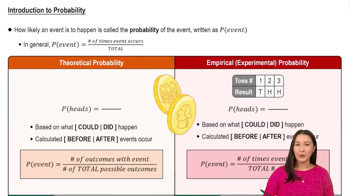
Classical probability is defined as the ratio of the number of favorable outcomes to the total number of possible outcomes in a probability experiment. It assumes that all outcomes are equally likely. For example, when rolling a 12-sided die, the total outcomes are 12, and the probability of rolling a specific number is 1/12.
Recommended video:
5:37
Introduction to Probability

Divisibility

Divisibility is a mathematical concept that determines whether one integer can be divided by another without leaving a remainder. In the context of the given problem, we are interested in the numbers on the die that are divisible by 5, which are 5 and 10. Understanding which numbers meet this criterion is essential for calculating the probability of event F.
Recommended video:
Guided course
07:32
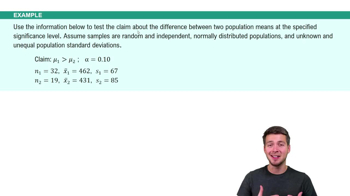
Difference in Means: Hypothesis Tests Example 1

Event and Sample Space

An event is a specific outcome or a set of outcomes from a probability experiment, while the sample space is the set of all possible outcomes. In this case, the sample space consists of the numbers 1 through 12 on the die, and event F includes the outcomes that are divisible by 5. Identifying the event and sample space is crucial for calculating the probability of event F.
Recommended video:
05:11
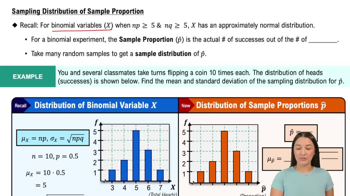
Sampling Distribution of Sample Proportion
Related Practice
Textbook Question

"Identifying Simple Events In Exercises 33-36, determine the number of outcomes in the event. Then decide whether the event is a simple event or not. Explain your reasoning.

36. You randomly select one card from a standard deck of 52 playing cards. Event B is selecting the ace of spades."

Textbook Question

3. What does the notation P(B|A) mean?

Textbook Question

Odds The chances of winning are often written in terms of odds rather than probabilities. The odds of winning is the ratio of the number of successful outcomes to the number of unsuccessful outcomes. The odds of losing is the ratio of the number of unsuccessful outcomes to the number of successful outcomes. For example, when the number of successful outcomes is 2 and the number of unsuccessful outcomes is 3, the odds of winning are 2 : 3 (read "2 to 3"). In Exercises 91-96, use this information about odds.

92. The probability of winning an instant prize game is 1/10. The odds of winning a different instant prize game are 1 : 10. You want the best chance of winning. Which game should you play? Explain your reasoning.

Textbook Question

True or False? In Exercises 3-6, determine whether the statement is true or false. If it is false,

explain why.

4. When two events are independent, they are also mutually exclusive.

Textbook Question

Graphical Analysis In Exercises 7 and 8, determine whether the events shown in the Venn diagram are mutually exclusive. Explain your reasoning.

Textbook Question

Identifying the Sample Space of a Probability Experiment In Exercises 25-32, identify the sample space of the probability experiment and determine the number of outcomes in the sample space. Draw a tree diagram when appropriate.

25. Guessing the initial of a student's middle name