
Textbook Question
34. Lottery Number Selection A lottery has 52 numbers. In how many different ways can six of the numbers be selected? (Assume the order of selection is not important.)
 Verified step by step guidance
 05:17
05:17
 05:53
05:53 06:28
06:2834. Lottery Number Selection A lottery has 52 numbers. In how many different ways can six of the numbers be selected? (Assume the order of selection is not important.)
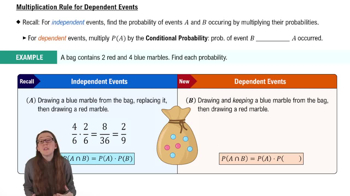
"Classifying Events as Independent or Dependent In Exercises 9-14, determine whether the events are independent or dependent. Explain your reasoning.
13. Rolling a six-sided die and then rolling the die a second time so that the sum of the two rolls is five"
Boy or Girl? In Exercises 71-74, a couple plans to have three children. Each child is equally likely to be a boy or a girl.
71. What is the probability that all three children are girls?
According to Bayes’ Theorem, the probability of event A , given that event B has occurred, is
P(A|B) = P(A) * P(B|A)P(A) * P(B|A) + P(A') * P(B|A').
In Exercises 33–38, use Bayes’ Theorem to find P(A|B).
37. P(A) = 73%, P(A') = 17%, P(B|A) = 46% , and P(B|A') = 52%
20. Skating Eight people compete in a short track speed skating race. Assuming that there are no ties, in how many different orders can the skaters finish?
97. Rolling a Pair of Dice You roll a pair of six-sided dice and record the sum.
a. List all of the possible sums and determine the probability of rolling each sum.
b. Use technology to simulate rolling a pair of dice and record the sum 100 times. Make a tally of the 100 sums and use these results to list the probability of rolling
each sum.
c. Compare the probabilities in part (a) with the probabilities in part (b). Explain any similarities or differences.