Ch. 3 - Probability
Larson - Elementary Statistics: Picturing the World 8th Edition
Larson8th EditionElementary Statistics: Picturing the WorldISBN: 9780137493470Not the one you use?Change textbook
Chapter 3, Problem 3.2.10

"Classifying Events as Independent or Dependent In Exercises 9-14, determine whether the events are independent or dependent. Explain your reasoning.
10. A father having hazel eyes and a daughter having hazel eyes"

Verified step by step guidance
1
Step 1: Understand the concept of independent and dependent events. Independent events are those where the occurrence of one event does not affect the probability of the other event. Dependent events are those where the occurrence of one event does affect the probability of the other event.
Step 2: Analyze the relationship between the father having hazel eyes and the daughter having hazel eyes. Consider whether the genetic inheritance of eye color plays a role in determining the probability of the daughter having hazel eyes.
Step 3: Recall that eye color is influenced by genetics. A father having hazel eyes increases the likelihood of the daughter inheriting hazel eyes due to shared genetic traits. This suggests a dependency between the two events.
Step 4: Formulate the reasoning: Since the probability of the daughter having hazel eyes is affected by the father’s eye color (due to genetic inheritance), these events are dependent.
Step 5: Conclude that the events are dependent and explain that the dependency arises from the genetic relationship between the father and daughter, which influences the likelihood of shared traits like eye color.

Verified video answer for a similar problem:

This video solution was recommended by our tutors as helpful for the problem above.
Video duration:
1m
Was this helpful?

Key Concepts

Here are the essential concepts you must grasp in order to answer the question correctly.

Independent Events

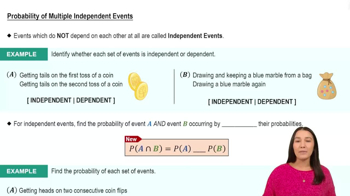
Independent events are those whose outcomes do not affect each other. In probability, two events A and B are independent if the occurrence of A does not change the probability of B occurring, and vice versa. For example, flipping a coin and rolling a die are independent events because the result of one does not influence the other.
Recommended video:
05:54
Probability of Multiple Independent Events

Dependent Events

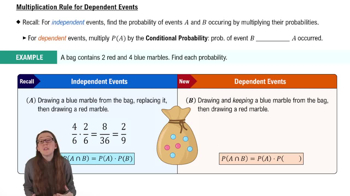
Dependent events are those where the outcome of one event affects the outcome of another. In probability, two events A and B are dependent if the occurrence of A changes the probability of B occurring. For instance, drawing cards from a deck without replacement creates dependent events, as the first draw alters the composition of the deck for the second draw.
Recommended video:
05:17
Multiplication Rule: Dependent Events

Genetic Inheritance

Genetic inheritance refers to the way traits and characteristics are passed from parents to offspring through genes. In the context of the question, the eye color of a father and daughter can be influenced by their genetic makeup, which may indicate a dependent relationship. The probability of the daughter having hazel eyes is affected by the father's eye color, illustrating how genetic traits can be interrelated.
Related Practice
Textbook Question

56. Defective Disks A pack of 100 recordable DVDs contains 5 defective disks. You select four disks. What is the probability of selecting at least three non defective disks?
Textbook Question

Odds The chances of winning are often written in terms of odds rather than probabilities. The odds of winning is the ratio of the number of successful outcomes to the number of unsuccessful outcomes. The odds of losing is the ratio of the number of unsuccessful outcomes to the number of successful outcomes. For example, when the number of successful outcomes is 2 and the number of unsuccessful outcomes is 3, the odds of winning are 2 : 3 (read "2 to 3"). In Exercises 91-96, use this information about odds.

94. A card is picked at random from a standard deck of 52 playing cards. Find the odds that it is a spade.

Textbook Question

Identifying the Sample Space of a Probability Experiment In Exercises 25-32, identify the sample space of the probability experiment and determine the number of outcomes in the sample space. Draw a tree diagram when appropriate.

32. Rolling a six-sided die, tossing two coins, and spinning the fair spinner shown

Textbook Question

Using the Fundamental Counting Principle In Exercises 37-40, use the Fundamental Counting Principle.

37. Menu A restaurant offers a \$15 dinner special that lets you choose from 6 appetizers, 12 entrées, and 8 desserts. How many different meals are available when you select an appetizer, an entrée, and a dessert?

Textbook Question

3. Explain why the statement is incorrect: The probability of rain is 150%.

Textbook Question

In Exercises 15-18, determine whether the situation involves permutations, combinations, or neither. Explain your reasoning.

17. The number of ways 2 captains can be chosen from 28 players on a lacrosse team