
Textbook Question
Using the Multiplication Rule In Exercises 19-32, use the Multiplication Rule.
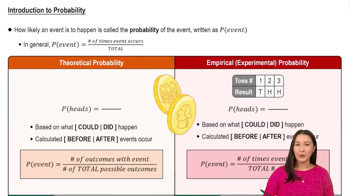
20. Coin and Die A coin is tossed and a die is rolled. Find the probability of tossing a tail and then rolling a number greater than 2.
 Verified step by step guidance
 5:37
5:37
 05:22
05:22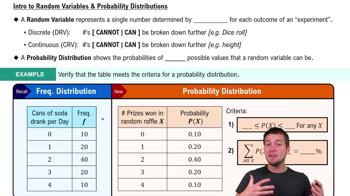 07:09
07:09Using the Multiplication Rule In Exercises 19-32, use the Multiplication Rule.
20. Coin and Die A coin is tossed and a die is rolled. Find the probability of tossing a tail and then rolling a number greater than 2.
"Classifying Events as Independent or Dependent In Exercises 9-14, determine whether the events are independent or dependent. Explain your reasoning.
9. Selecting a king from a standard deck of 52 playing cards, replacing it, and then selecting a queen from the deck"
Writing In Exercises 89 and 90, write a statement that represents the complement of the probability.
90. The probability of randomly choosing a car with more than one cause for showing its "CHECK ENGINE" light from the population of vehicles showing "CHECK ENGINE" lights.
Classifying Events as Independent or Dependent In Exercises 9-14, determine whether the events are independent or dependent. Explain your reasoning.
14. A ball is selected from a bin of balls numbered from 1 through 52. It is replaced, and then a second numbered ball is selected from the bin.
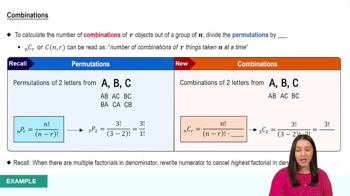
37. Water Pollution An environmental agency is analyzing water samples from 80 lakes for pollution. Five of the lakes have dangerously high levels of dioxin. Six lakes are randomly selected from the sample. Use technology to find how many ways one polluted lake and five nonpolluted lakes can be chosen.
Using a Frequency Distribution to Find Probabilities In Exercises 49-52, use the frequency distribution at the left, which shows the population of the United States by age group, to find the probability that a U.S. resident chosen at random is in the age range. (Source: U.S. Census Bureau)
52. 65 years old and older