Ch. 3 - Probability
Larson - Elementary Statistics: Picturing the World 8th Edition
Larson8th EditionElementary Statistics: Picturing the WorldISBN: 9780137493470Not the one you use?Change textbook
Chapter 3, Problem 3.3.29

29. Explain, in your own words, why in the Addition Rule for P(A or B or C), P(A and B and C) is added at the end of the formula.

Verified step by step guidance
1
The Addition Rule for P(A or B or C) is used to calculate the probability of at least one of the events A, B, or C occurring. The formula accounts for the overlap between events to avoid overcounting.
When adding P(A), P(B), and P(C), the overlaps between pairs of events (e.g., P(A and B), P(A and C), P(B and C)) are included multiple times, so we subtract these pairwise intersections to correct for overcounting.
However, when we subtract the pairwise intersections, we inadvertently remove the probability of the triple intersection, P(A and B and C), too many times (once for each pair).
To correct this, we add P(A and B and C) back to the formula. This ensures that the probability of all three events occurring simultaneously is properly accounted for.
Thus, the term P(A and B and C) is added at the end of the formula to ensure the final probability calculation is accurate and avoids both overcounting and undercounting.

Verified video answer for a similar problem:

This video solution was recommended by our tutors as helpful for the problem above.
Video duration:
3m
Was this helpful?

Key Concepts

Here are the essential concepts you must grasp in order to answer the question correctly.

Addition Rule of Probability

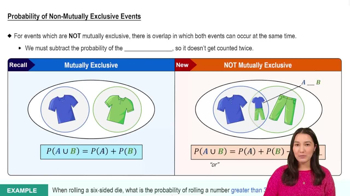
The Addition Rule of Probability is a fundamental principle that calculates the probability of the occurrence of at least one of several events. It states that to find the probability of A or B or C occurring, you must sum the individual probabilities of each event and subtract the probabilities of their intersections to avoid double counting. This rule is essential for understanding how probabilities combine in scenarios involving multiple events.
Recommended video:
5:14
Probability of Non-Mutually Exclusive Events

Intersection of Events

The intersection of events refers to the scenario where two or more events occur simultaneously. In the context of the Addition Rule, P(A and B and C) represents the probability that all three events occur at the same time. This term is added at the end of the formula to ensure that the probability of all events happening together is included, preventing the underestimation of the total probability when events overlap.
Recommended video:
05:54
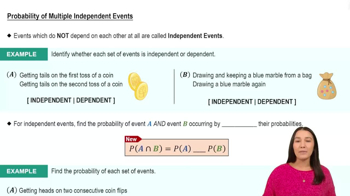
Probability of Multiple Independent Events

Overlapping Events

Overlapping events occur when two or more events share common outcomes, leading to potential double counting in probability calculations. In the Addition Rule, it is crucial to account for these overlaps by adding the intersection probabilities back into the total. This ensures that the final probability accurately reflects the likelihood of at least one of the events occurring without redundancy.
Recommended video:
05:54
Probability of Multiple Independent Events